
Civil War Forage Cap and Knapsack Sergeant Austin C. Stearns, 13th Massachusetts Regiment Identified Forage Cap and Knapsack
$9,500.00
Description
Civil War Forage Cap and Knapsack Sergeant Austin C. Stearns, 13th Massachusetts Regiment
His Identified Forage Cap and Knapsack
Author of Three Years with Company K
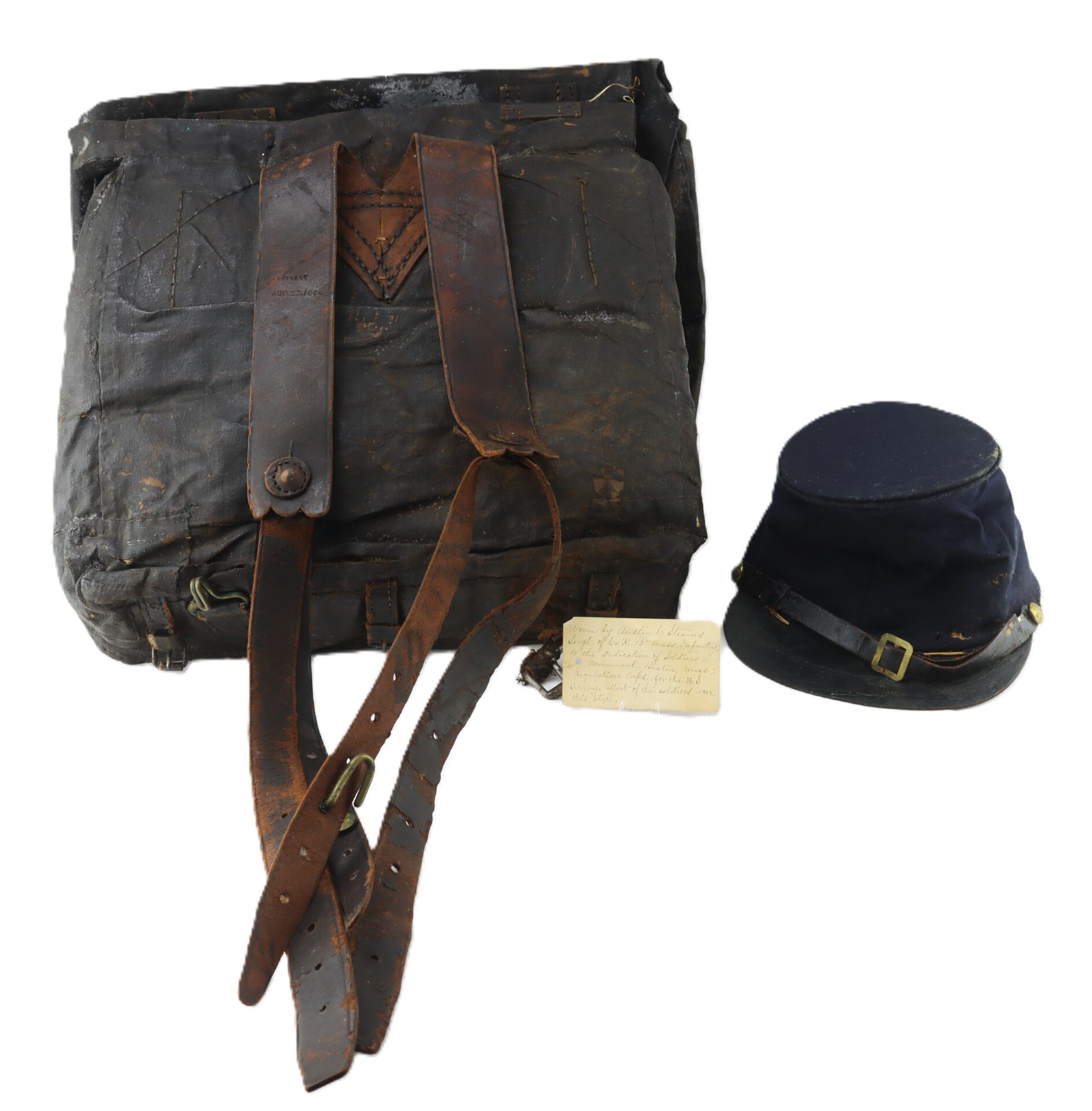
An exceptional pair of identified personal effects belonging to Sergeant Austin C. Stearns of Company K, 13th Massachusetts Volunteer Infantry: his original U.S. Army forage cap and painted knapsack. Stearns served nearly the entirety of the regiment’s three-year enlistment and left behind an important first-person account of infantry service in the Army of the Potomac, later published as Three Years with Company K.
The forage cap is constructed of regulation blue wool with leather visor and chin strap, retaining its glazed brown cotton lining and leather sweatband. The interior bears the inspector’s marking “E. WHEELER / INSPECTOR N.Y.” Remarkably, the reverse of the accompanying period tag specifically identifies the cap as having been worn by Austin C. Stearns, Sergeant of Company K, 13th Massachusetts Infantry, to the dedication of the Soldiers’ Monument in Boston, Massachusetts. Thus, the cap carries both a direct wartime association with Stearns and documented postwar veteran use.
The accompanying painted knapsack with leather straps is equally significant and is accompanied by an extraordinary handwritten provenance tag identifying Stearns by name and providing his own detailed account of how he carried his equipment in the field.
Transcription of Tag
Front:
Knapsack
“Carried by Sergt. Austin C. Stearns from about June 1, 1863 to Aug. 11, 1864. This is the 3rd or 4th used during the 3 years. It was used for woolen and rubber blankets, rolled and strapped on the top. Quilt was folded and placed between flap + box; over-coat in the flap; underclothing and ditty bag in the box; also extra ammunition and hard tack. Bottles, toothbrush, pills for diarrhea, rum—camphor, pins, all-purpose duty, etc. Materials Station. winter of ’63–4, Wilderness, Laurel Hill, Spotsylvania, Nye River, North Anna, Bethesda Church, Cold Harbor, White Oak Swamp, Petersburg.”
Reverse:
“Worn by Austin C. Stearns – Sergt. of Co. K, 13th Mass. Infantry, to the dedication of Soldiers Monument, Boston, Mass. Regulation Cap for the U.S. Army. Most of the soldiers wore this style.”
The tag records how a Civil War infantryman actually packed his knapsack. Wool and rubber blankets were rolled and strapped across the top; his quilt was folded beneath the flap; his overcoat, underclothing and ditty bag were carried within, together with extra ammunition, hardtack, medicines and assorted personal necessities. Few surviving identified knapsacks retain such a detailed first-person explanation of their actual field use.
Although the old tag gives a general starting date of approximately June 1863 and states that this was Stearns’s “3rd or 4th” knapsack, examination of the surviving knapsack indicates a manufacture or issue date of approximately August 1864. It therefore could not have been the knapsack Stearns carried at Gettysburg in July 1863. Instead, it appears to have been a later replacement—most likely the fourth knapsack issued to or used by Stearns during his three years of service. This is entirely consistent with Stearns’s own notation that he went through several knapsacks during his enlistment.
Stearns’s 1864 campaigning included the Wilderness, Laurel Hill, Spotsylvania Court House, Nye River, North Anna, Bethesda Church, Cold Harbor, White Oak Swamp and the opening operations before Petersburg—the very campaigns specifically recorded on the provenance tag.
Stearns and the 13th Massachusetts at Gettysburg
Stearns had already experienced some of the hardest fighting of the war. At Gettysburg on July 1, 1863, the 13th Massachusetts fought with Paul’s Brigade, Robinson’s Division, First Corps, Army of the Potomac. The regiment became heavily engaged northwest of town in the fighting around the Mummasburg Road and Oak Ridge, where Robinson’s men resisted increasingly powerful Confederate attacks before the First and Eleventh Corps were compelled to withdraw through Gettysburg.
Stearns survived that desperate first day at Gettysburg and remained with the regiment into 1864. By the following spring he was among the veteran soldiers who entered Grant’s relentless Overland Campaign, fighting from the Wilderness through Spotsylvania, North Anna and Cold Harbor before reaching Petersburg.
Together they form an exceptionally personal record of a Gettysburg veteran, Army of the Potomac infantryman, and published chronicler of Company K of the 13th Massachusetts.
Inventory Number: GRO 110


Related products
-

Apothecary Bottle – CALCIS. HYPOPH.
$70.00 Add to cart -
English Pistol with Brass Barrel and Grotesque Mask Butt Cap
$895.00 Add to cart -
Ivory Day Planner, Charles Weckerle Battery E, 2nd U.S. Light Artiller
$675.00 Add to cart -
Check Signed by Civil War Photographer Alexander Gardner
$950.00 Add to cart



Reviews
There are no reviews yet.