
- You cannot add that amount to the cart — we have 1 in stock and you already have 1 in your cart. View cart
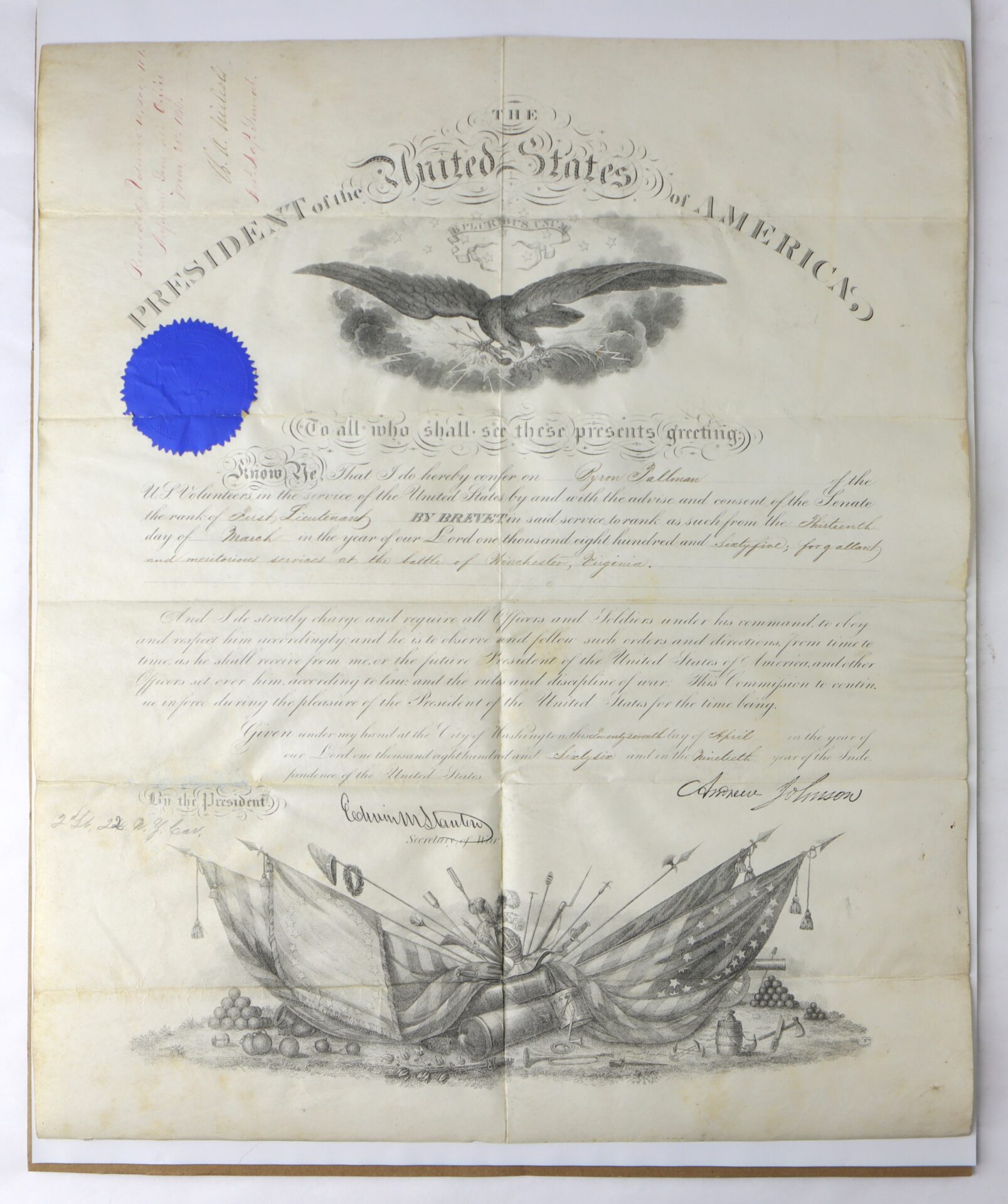
United States Presidential Commission Byron Tallman of the 22nd New York Cavalry Meritorious Service at the Battle of Winchester Said to have Captured Harry Gillmore
$595.00
Description
United States Presidential Commission
Byron Tallman of the 22nd New York Cavalry
Meritorious Service at the Battle of Winchester
Said to have Captured Harry Gillmore
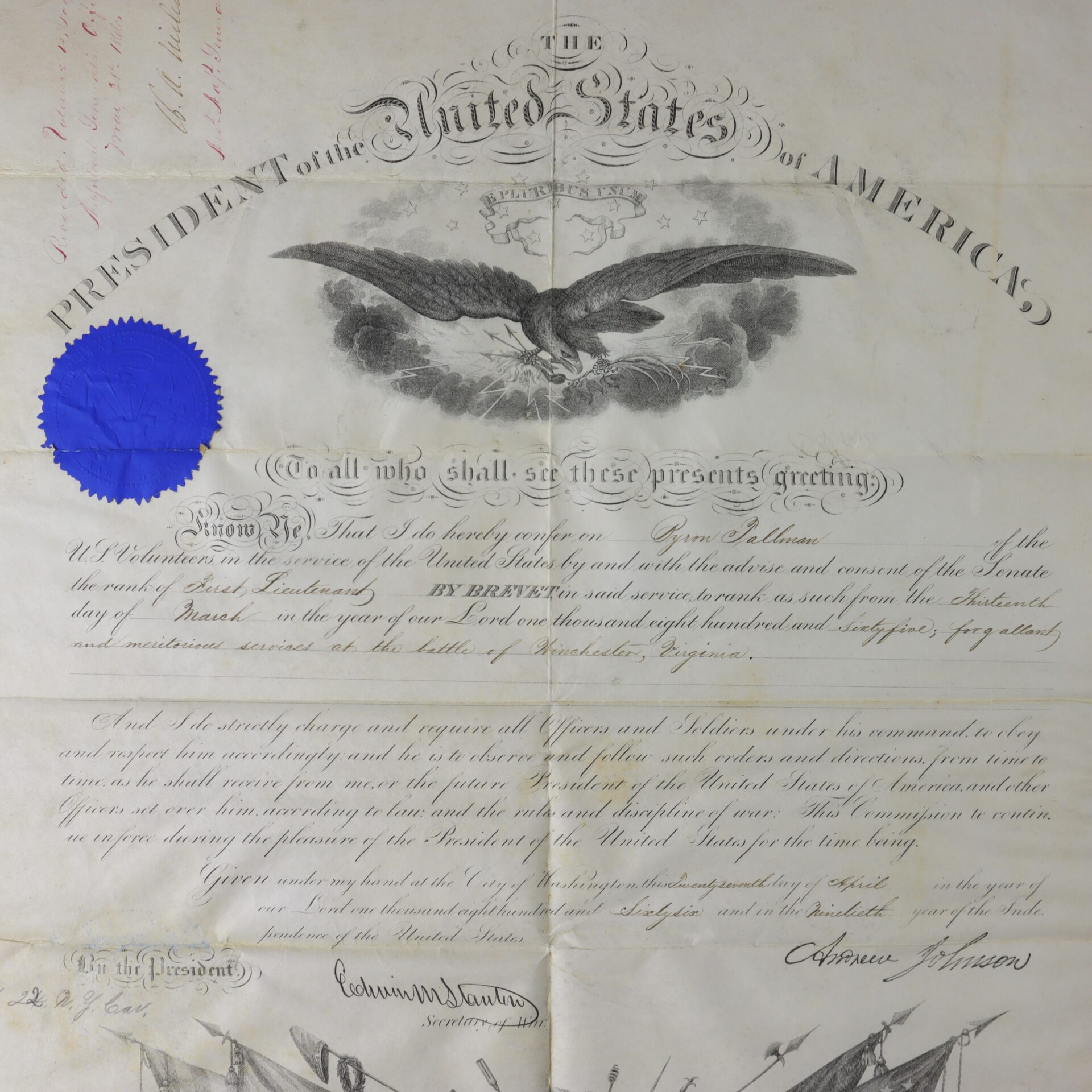
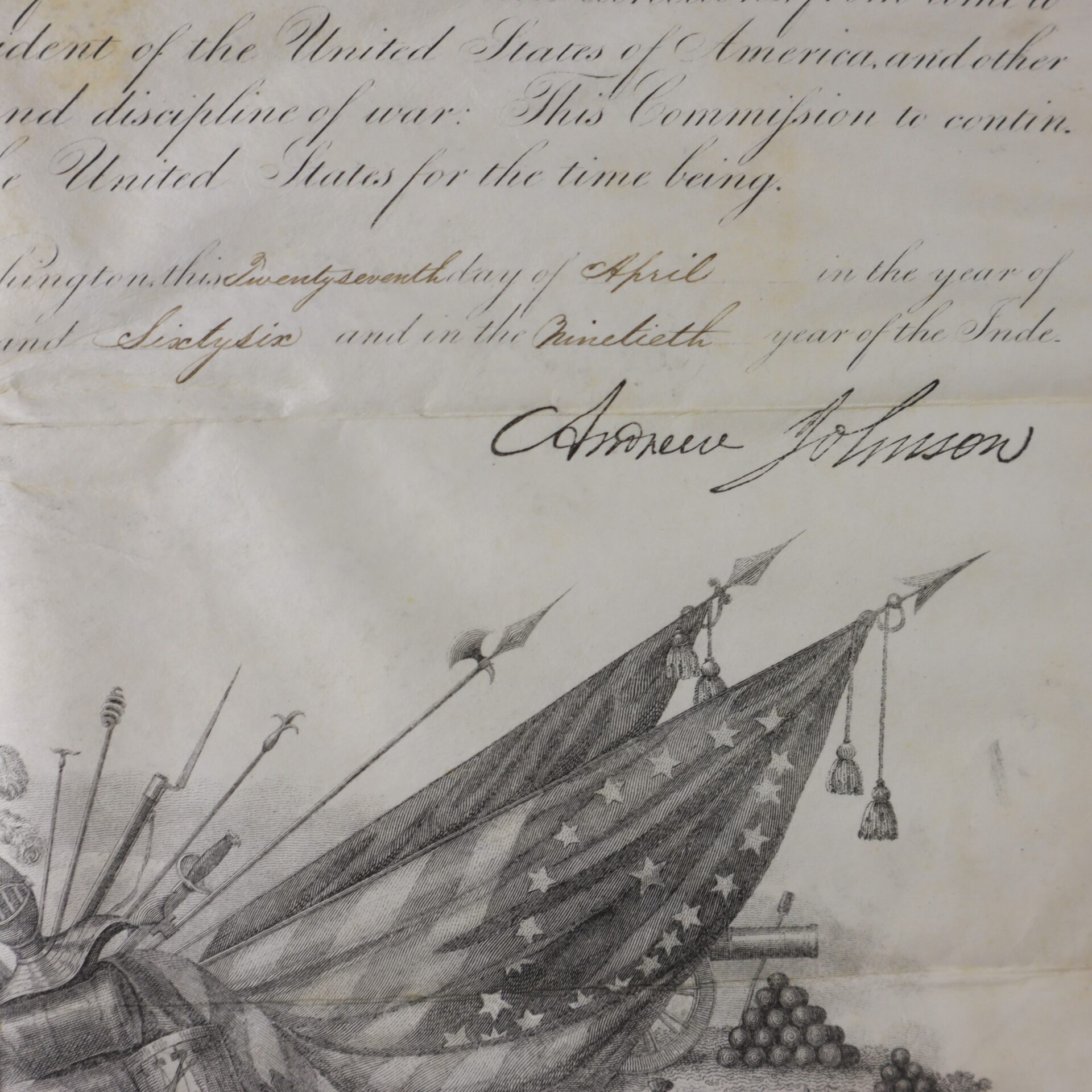
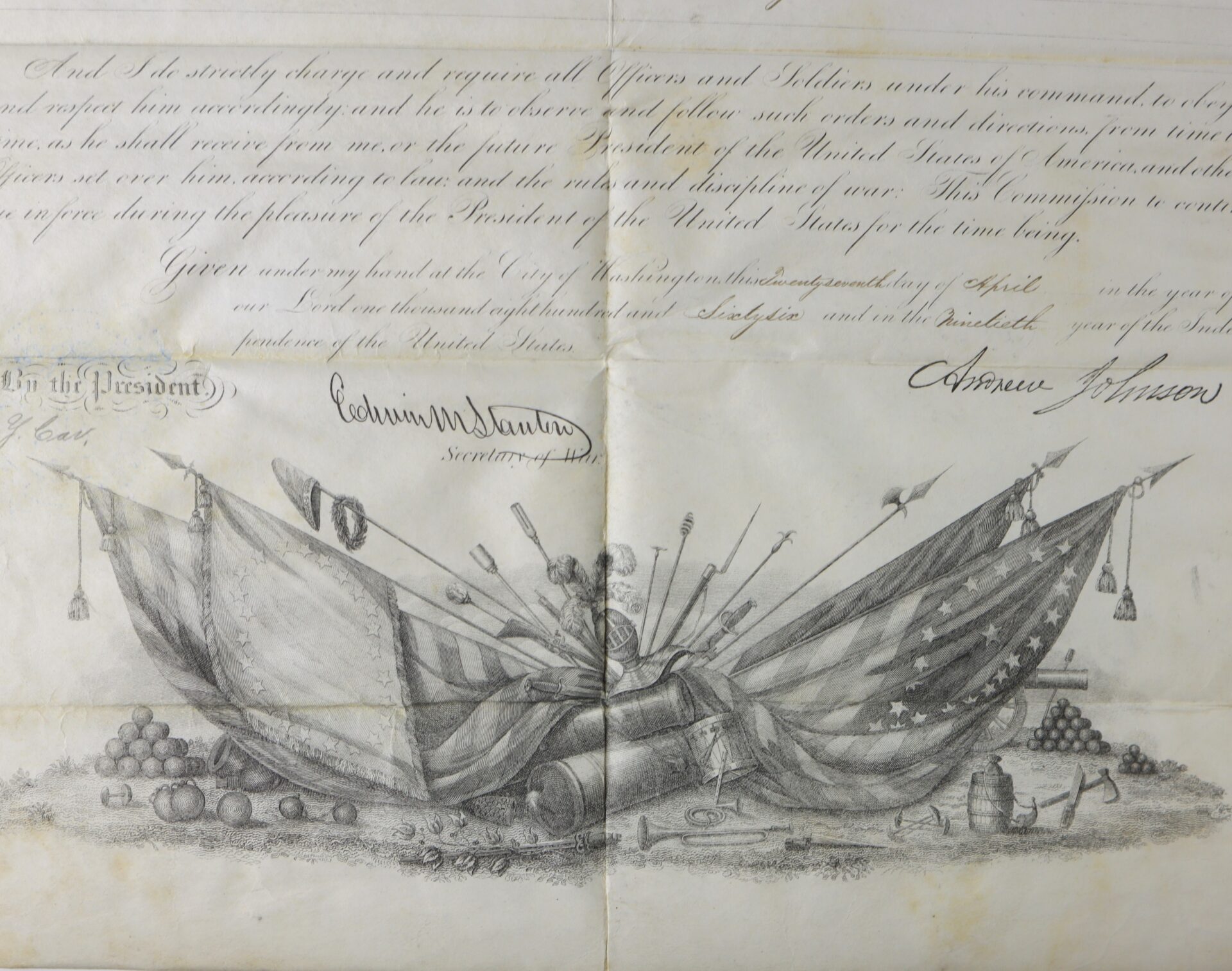
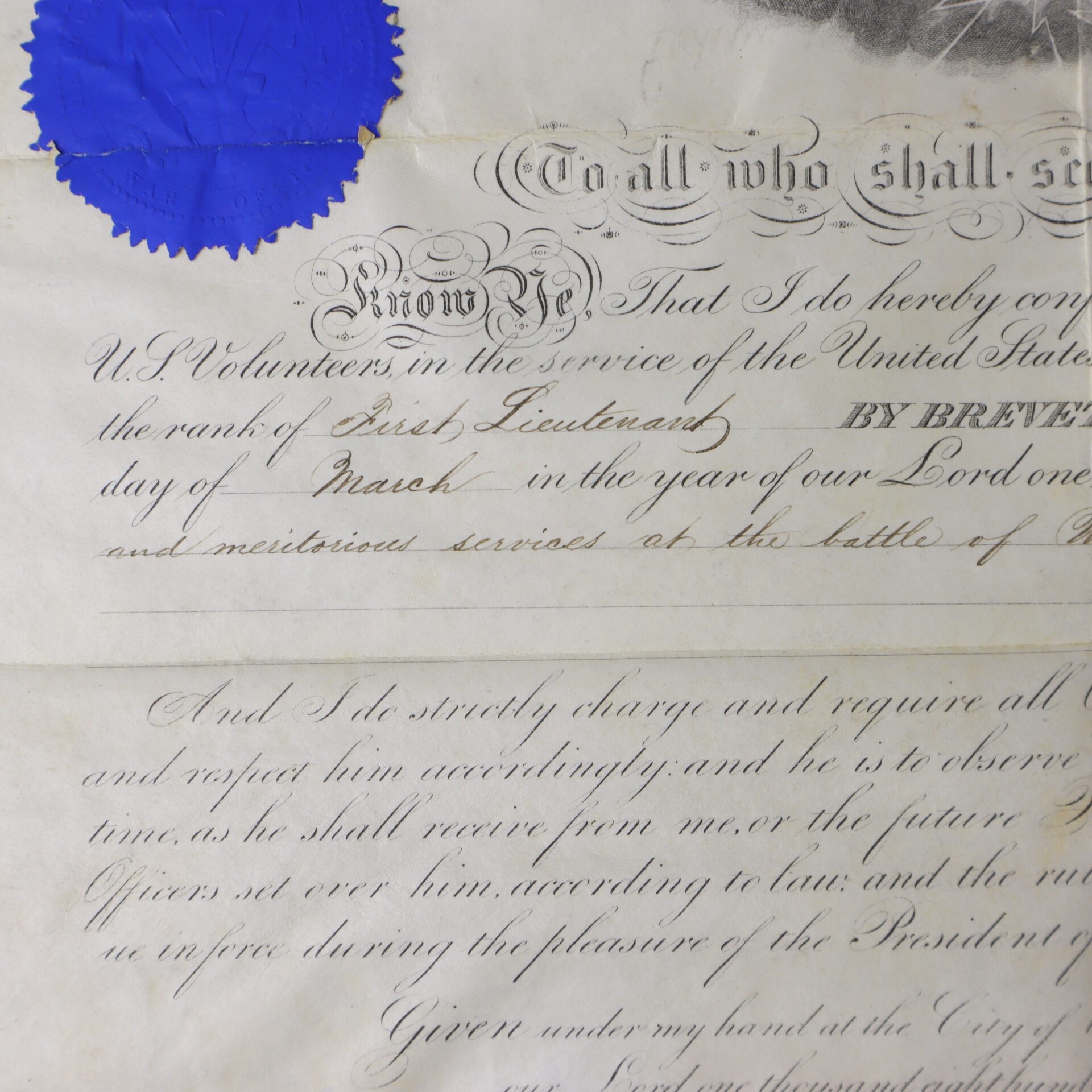
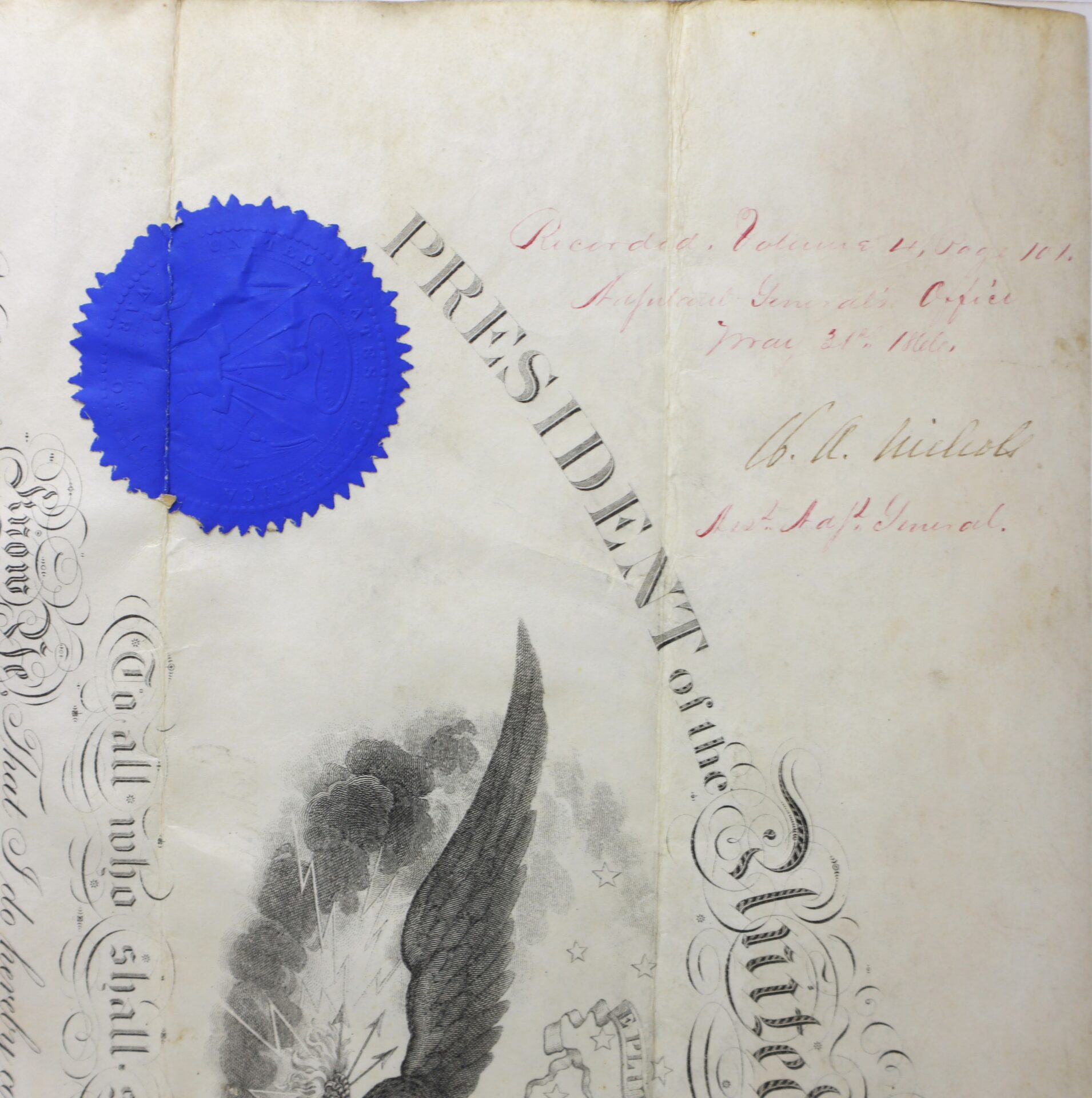
This original Civil War United States Army commission was issued under the authority of President Andrew Johnson. It bears his stamped ink signature and the embossed blue War Department seal. The document features the classic mid-19th century engraved eagle vignette clutching arrows and an olive branch, surrounded by dramatic lightning and cloud motifs. This is the standard federal commission format used during the latter years of the war.
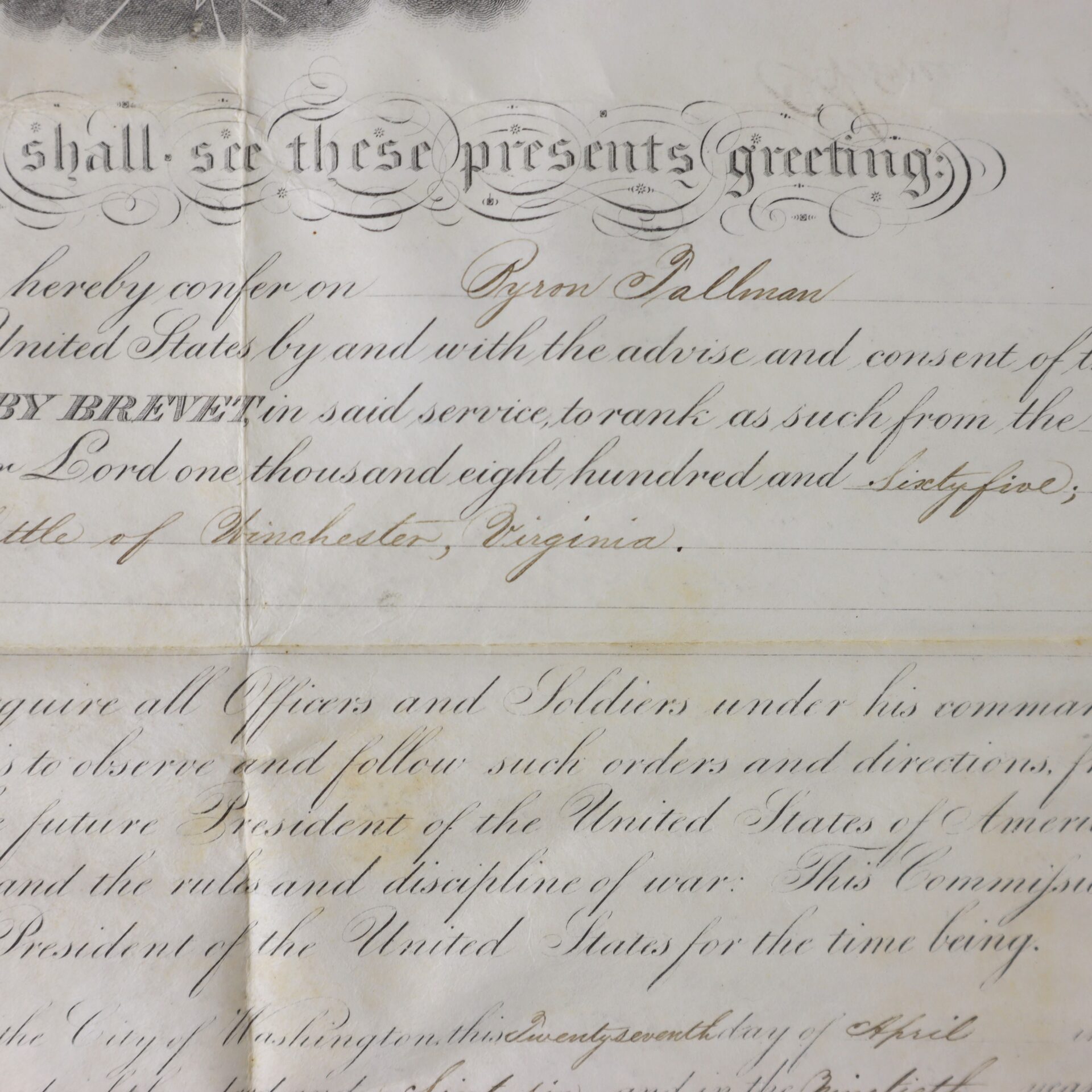
The text reads in part: “Andrew Johnson, President of the United States of America, with special trust and confidence in the patriotism, valor, fidelity, and abilities of Byron Tallman, do appoint him First Lieutenant in the Army of the United States…”
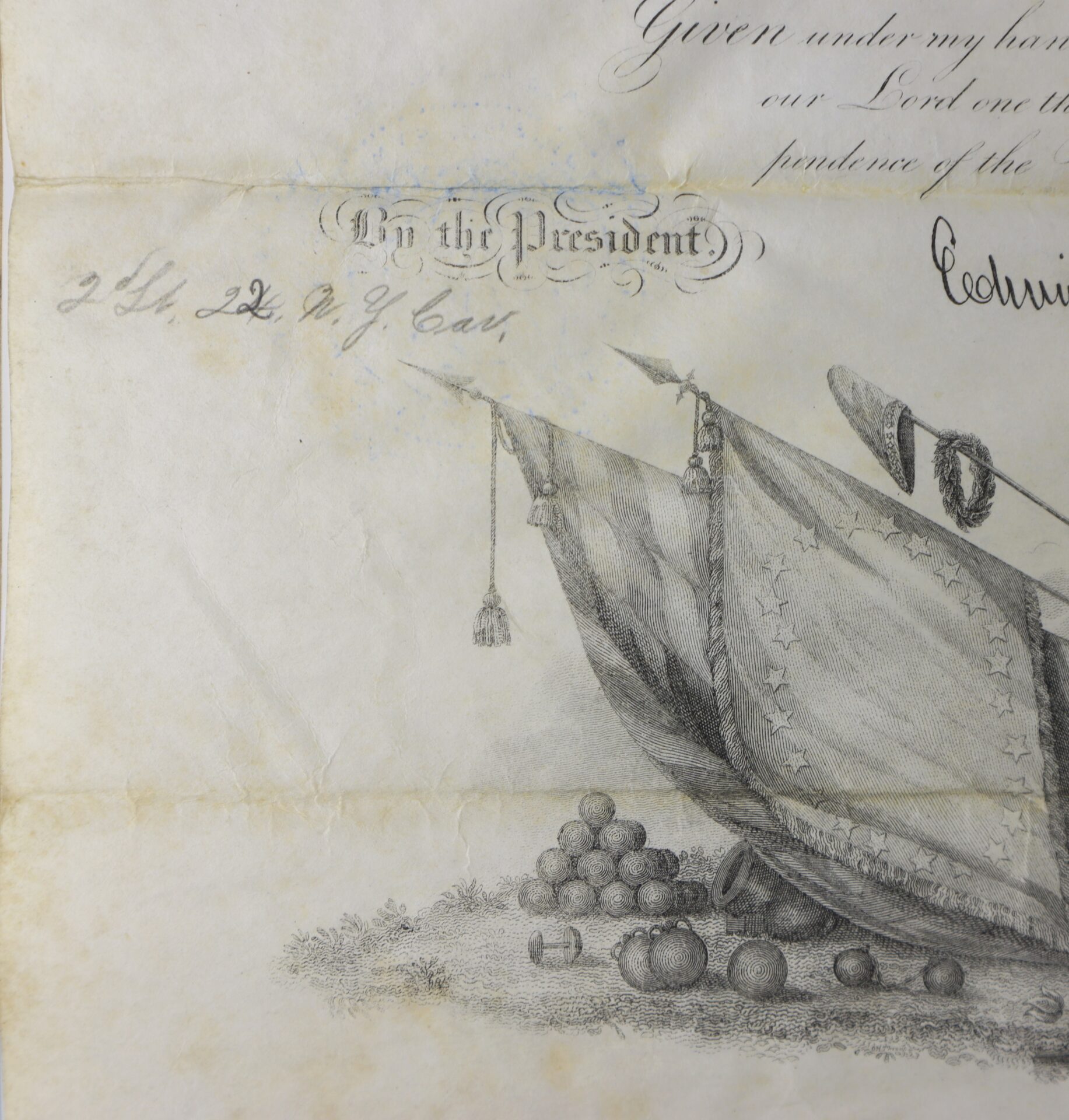
The commission is countersigned by the Secretary of War and properly impressed with the large blue embossed seal of the War Department.
This commission was issued to a member of the 22nd New York Infantry, a regiment organized in New York City in May 1861 for two years of service. The 22nd NY participated in hard campaigning in the Army of the Potomac and was heavily engaged during the Shenandoah Valley operations, including the fighting at Winchester. The various Battles of Winchester, particularly the First Winchester in May 1862 and the later Valley campaigns, were strategically crucial engagements in the struggle for control of the Shenandoah Valley, which was considered the “breadbasket of the Confederacy.”
By the time Andrew Johnson’s signature appears on commissions (after Lincoln’s assassination in April 1865), many officers were receiving brevet promotions or final confirmations of rank in recognition of wartime service. Johnson-signed Civil War commissions are historically important as they mark the immediate post-assassination transition of executive authority during the closing days of the war and the beginning of Reconstruction.
The document retains strong, legible manuscript text with Johnson’s stamped signature intact. The blue embossed War Department seal remains crisp and prominent. Usual horizontal and vertical folds from period storage. Minor age toning consistent with Civil War documents.
The 22nd New York Cavalry was originally organized as the 3rd New York Mounted Rifles and later redesignated the 22nd New York Cavalry in early 1865. They were heavily engaged in the Shenandoah Valley Campaign under General Philip Sheridan, including operations connected to the Third Battle of Winchester (September 19, 1864) one of the most decisive Union victories in the Valley.
Byron M. Talman
The oldest son of John Talman he was born in 1839 in Perinton, New York and received his early education in local schools. His volunteer paper described him as being 5’11”, with black hair, hazel eyes and a ruddy complexion. On October 12th 1863, Talman was among the first to enlist in Company “A” of the 22nd NY Cavalry. As more men volunteered, Companies “B” through “M” were formed. Talman was 25, had a wife, and had already sailed the Atlantic and Mediterranean. His father and uncle were abolitionists, and their homes were used for part of the Underground Railroad and had campaigned for Lincoln in Perinton and Rochester. Talman was Company “A’s” 1st Sergeant during the Overland Campaign. For the Shenandoah Campaign, he was commissioned 2nd Lieut. Aug. 9, 1864 and joined Company “H” on August 10th. Later he would command Company “M” and would frequently be in command of the battalion or regiment.
The 22nd participated in two great campaigns — the Overland Campaign and the (Shenandoah) Valley Campaign. During the Overland Campaign, Sheridan’s Cavalry Corps was attached to Grant’s Army of the Potomac as it progressed southward toward the Confederate capital, fighting battles at the Wilderness, Spotsylvania, and Cold Harbor. When battle lines became entrenched at Richmond and Petersburg, Grant made Sheridan’s Cavalry Corps into the autonomous Army of the Shenandoah. Their mission was to halt Confederate military operations in western Virginia and to eliminate the threat of attack on Washington. By 1864, Federal control of the Shenandoah Valley of Virginia was viewed as necessary to a Union victory because of the Valley’s configuration and its economic potential to the Confederate war effort. The Valley had seen little warfare since General Stonewall Jackson’s brilliant campaign had secured it as a Confederate supply base in 1862. The Valley Campaign fought battles at Opequon (Winchester), Cedar Creek, and Waynesboro. All of these battles, from the Wilderness to Waynesboro, are considered major battles, critical to the war’s outcome. The 22nd fought them all within a six month period and suffered high casualties.
The legacy of the 22nd and the Cavalry Corps is significant. When the war began, the Union Army had no effective cavalry. In contrast, the Confederacy had the illustrious cavalryman J.E.B. Stuart. By the end of the campaigns, Stuart had been removed and the reputations of Generals Sheridan, Custer and Wesley Merritt were established. In his farewell address to the division, Custer said, “In the past six months, although confronted by superior numbers,… you have never lost a gun, never lost a color, and have never been defeated.”
Talman received a gunshot wound to his left arm at Opequon (Winchester). There are several accounts. General Custer reported, “The enemy upon our approach delivered a well-directed volley of musketry, but before a second discharge could be given my command was in their midst, sabering right and left.” Talman’s brother, a journalist and historian, wrote, “he was shot in the left arm while leading a charge, but fought on until, faint from loss of blood, his colonel forced him to the rear.” In his promotion to Captain and to the command of Company M, the Army record cited his “gallant and meritorious services at the Battle of Winchester, Va.” One press release stated, “the [22nd N Y Cavalry] regiment captured four of the nine battle flags,” and credits Talman among others. These flags were presented by Custer and Sheridan to Secretary of War Edwin M. Stanton.
Major Harry Gilmor was a Confederate raider who destroyed railroad bridges near Washington in Maryland and West Virginia. As the Confederacy grew desperate, Gilmor terrorized civilians and burned towns, such as Chambersburg, PA, entirely to the ground.
According to another regimental history of that time, Sheridan had scouts, Union soldiers who had been selected with for their courage and fitness for this dangerous work. They tracked Gilmor, and on 4 Feb 1865, they found him in bed, sound asleep, his revolver on a chair nearby. Gilmor was imprisoned for the remainder of the war.
Byron Talman’s role in Gilmor’s capture is unclear. The story was not told during Talman’s life, but it is consistent with the known facts.
Was Talman ever a scout for Sheridan? In the Monroe County Mail for 13 Feb 1919, Talman’s brother says, “In the Battle of the Wilderness, Byron led a squad of troopers detailed to carry dispatches between Gen. Grant and his corps commanders [who included Sheridan] and half the time was inside the Confederate lines.” This is consistent with deployment of the regiment at the Wilderness.
Was Talman serving as Sheridan’s scout in February 1865? The Army record indicates that he was present but unattached to a unit from January through March 1865.
Was Talman involved with Gilmor’s capture? In the Monroe County Mail for 19 Feb 1929, Talman’s brother writes, “It was he, single-handed, who captured Major Harry Gilmor, the Confederate officer, after pursuing him three days and three nights without sleep. It was a bit singular that the two men, both large and powerful, were almost doubles.”
This account of “single-handed” capture mocks Gilmor, who was an exceptional braggart, boasting in the newspapers and defying his pursuers. If Talman wasn’t indeed alone when he captured Gilmore, he was certainly one of many involved in the pursuit.
Talman was mustered out of the service on August 1, 1865 at Winchester, VA Captain of Company “M”.
The following is from the St. Paul Dispatch, of November 15th, 1909 and refers to a former resident of-this town.-a son of the late John Talman: “Byron Talman, brother of John Talman Jr, the assistant librarian of the Minnesota State Historical Society, died at the Mounds View hotel, New Brighton, this morning, at the age of seventy-one years. Arrangements for the funeral have not yet been made. Last winter Mr. Talman was severely injured by a falling tree and, while he thought he had entirely recovered from the effects of the injury, complications set in which caused his death.
Mr. Talman, who was born near Fairport, N.Y., had an enviable reputation as a soldier won during the Civil War. He was a brevet captain of Company “M”, Twenty-second New York Calvary and during the war was frequently in command of either a battalion or regiment. He was promoted for gallantry at the battle of Winchester and at the battle of the Wilderness he was in command of 25 troops who carried dispatches to General Grant. In pursuit of General Early, Mr. Talman recovered field dispatches and official papers which he kept during the rest of his life. Mr. Talman came to Minnesota in 1865, but in the next year left for Iowa where he lived until four years ago, when he returned to Minnesota and settled on a farm near Fridley. He is survived by wife Elizabeth and the following children : Charles B., of Antler, Saskatchewan; Can., William H , Denver, Col.; Mrs. I. O. Thompson, Buhl, Idaho; Mrs. Peter Ackerman, Estherville, Iowa, and Clara Talman, Emmettsbury, Iowa, and a sister, Mrs. Harriet Colvin, of Denver, and brother, John Talman Jr, of St. Paul.”
Byron was buried in Williams Cemetery, Hamilton County, Iowa.
Inventory Number: DOC 411


Reviews
There are no reviews yet.