
Gettysburg Commander Grouping – Lt. Colonel John A. Steiner Collection
$27,500.00
Description
Gettysburg Commander Grouping
“On July 3, the Confederates made an all-out attack on Culp’s Hill. The 1st Potomac Home Brigade was ordered to relieve a Pennsylvania regiment that was out of ammunition. Lt. Colonel Steiner commanded the left of the line. The fighting was intense, and the regiment lost almost 100 men in only half an hour. Pickett’s Charge failed, as did the attack on Culp’s Hill. The Confederates began their retreat to the Potomac River on the night of July 4 and crossed back into Virginia on July 14. Two days later Steiner’s resignation took effect.”
Lt. Colonel John A. Steiner Collection
John Alexander Steiner was born in Frederick, Maryland on March 16, 1816. The 1859 City Directory shows him operating a brick yard on Patrick Street (now East Street). The First Regiment Potomac Home Brigade Infantry was organized in Frederick during the second half of 1861. John Steiner enlisted on October 22 with the rank of major.¹
The 1st Potomac Home Brigade was part of the Railroad Brigade tasked with guarding the B&O Railroad in 1862. In September it was added to the garrison at Harpers Ferry and captured when that post was surrendered just prior to the Battle of Antietam on September 15, 1862. Steiner was part of the greatest surrender of U.S. forces until the fall of Corregidor during WWII—11,000 men. He and his regiment were paroled and marched to Ellicott Mills (now Ellicott City). From there they moved by train to Camp Parole near Annapolis. When it was exchanged, the 1st Potomac Home Brigade was sent to southern Maryland to disrupt blockade running between Maryland and Virginia.²
On February 6, 1863, Steiner was promoted to Lieutenant Colonel. On June 16, 1863, he submitted his resignation to take effect on July 1. Once he learned of the Confederate invasion, he stated that he did not want it to take effect until the Rebels had been driven out of Pennsylvania and Maryland. Thus, he fought in the Battle of Gettysburg of his own choosing.³
With a major Confederate invasion at hand, the Federal Government issued a call-up of home guard troops. The 1st Potomac Home Brigade took a steamer to Baltimore and then marched to Gettysburg. When it arrived on July 2, the regiment was put on the extreme right of the line on Culp’s Hill. They were now part of Lockwood’s Brigade, First Division of the 12th Corps.
At about 5:00 p.m., the brigade was ordered to the left to support an artillery battalion then under attack. Colonel William P. Maulsby led the regiment in a bayonet charge across the Trostle Farm and recaptured three Napoleons belonging to Bigelow’s Battery. The regiment lost 30 men in this action alone.
On July 3, the Confederates made an all-out attack on Culp’s Hill. The 1st Potomac Home Brigade was ordered to relieve a Pennsylvania regiment that was out of ammunition. Lt. Colonel Steiner commanded the left of the line. The fighting was intense, and the regiment lost almost 100 men in only half an hour. Pickett’s Charge failed, as did the attack on Culp’s Hill. The Confederates began their retreat to the Potomac River on the night of July 4 and crossed back into Virginia on July 14. Two days later Steiner’s resignation took effect.⁴
Steiner returned to his home in Frederick. In November of 1863, he was elected sheriff of Frederick County. On July 16, 1867, he was awarded the ranks of brevet colonel and brevet brigadier general “for faithful and meritorious services,” retroactive to March 13, 1865. John A. Steiner died on April 20, 1902, and is buried in Mount Olivet Cemetery, Frederick, Maryland, Section G, Lot 148.⁵
Footnotes
- Roger D. Hunt & Jack R. Brown, Brevet Brigadier Generals in Blue (Gaithersburg: 1990), p. 584; L. Allison Wilmer et al., (Baltimore: 1898), pp. 483–485.
- Daniel Carroll Toomey, The War Came by Train (Baltimore: 2013), pp. 96, 122.
- Combined Service Records, National Archives; Engelbrecht Diaries, Vol. 2, p. 235.
- Toomey, Marylanders at Gettysburg (Baltimore: 1994), pp. 8–9, 25–26; CSR Steiner.
- Engelbrecht, p. 249; CSR Steiner; Hunt, p. 584.
Published in Maryland in the Civil War and from the Author’s Collection. There is a letter of prevenance which accompanies the collection and reads as follows:
Letter of Provenance
Daniel C. Toomey
April 4, 2025
To whom it may concern,
I purchased the major part of the John A. Steiner collection from an out-of-state dealer named Jim Frasca in 1985. He purchased from a lady named Mrs. Cross, whom he met at one of Courtney Wilson’s Civil War shows. She came to the show with a single button and went around asking everyone how much they would give her. Frasca talked her into showing him what else she had and bought a group of items that he sold to me.
I in turn contacted Mrs. Cross and made several trips to her house to buy additional items. She was Colonel Steiner’s niece and up in age. Sometimes she was easy to deal with and other times not so much. Most items have Steiner’s name or initials on them.
Daniel C. Toomey
4-4-2025
Document 1 – JOHN A. STEINER
JOHN A. STEINER
Enlisted as Major in the First Potomac Home Brigade, Maryland Volunteers on October 22, 1861. Promoted to Lt. Colonel February 6, 1863. Resigned in June of 1863 to take effect on July 1, 1863. Steiner chose to remain with his unit on its march from southern Maryland to Gettysburg and actually participated in the fighting on July 2nd and 3rd. His discharge was amended to date from July 16, 1863. In 1865 Steiner received the brevet ranks of Colonel and Brig. General.
Steiner returned to his home in Frederick City, Maryland in 1863 and was elected sheriff. He was active in veterans’ affairs and a member of the Gettysburg Monument Commission in 1888.
Document 2 – THE MARYLAND POTOMAC HOME BRIGADE
In May of 1861 President Lincoln commissioned James Cooper of Frederick County a Brigadier General and authorized him to enlist a brigade of infantry for three years service. Cooper was soon transferred to General N. P. Banks’ army and Congressman Francis Thomas given the task of recruiting the balance of the four regiments. Their area of operation was to be from the Monocacy River to the western border of the state. By 1862 only three regiments had been organized and the brigade concept was abandoned. A fourth organization, the First Potomac Home Brigade Cavalry, was organized by Captain Henry A. Cole in 1861. First as a battalion and later as a regiment this unit usually operated on detached service.
The soldiers of the Potomac Home Brigade (P.H.B.) were primarily employed in guarding the B&O Railroad and the C&O Canal throughout the war. All three infantry regiments were captured at Harpers Ferry in 1862. The first of Cole’s Cavalry as it was known led all the Union cavalry to safety the night before the surrender.
Document 3 – FIRST REGIMENT POTOMAC HOME BRIGADE CAVALRY
Originally organized as a battalion of four companies by Captain Henry A. Cole in 1861 the unit was known from its inception as “Cole’s Maryland Cavalry.” The battalion was expanded to a full regiment in 1864 and the then Major Cole promoted to Colonel. Recruited in all parts of the state with a sprinkling of men from Pennsylvania, West Virginia, and Virginia, the regiment saw action on both sides of the Potomac River.
Because the troopers of Cole’s Cavalry possessed an intimate knowledge of the terrain from Gettysburg, Pennsylvania, to Lynchburg, Virginia, they were much sought after by Union commanders for scouting and raiding operations. A most familiar antagonist being Mosby’s Rangers. The regiment in whole or by detachments fought in over 80 engagements and suffered 169 battle related deaths.
.32 Caliber Rimfire Revolver by William Ullinger, Retailed by D.D. Cone of Washington D.C. — Identified to Lt. Col. James A. Steiner, 1st Maryland Potomac Home Brigade
An exceptional and exceedingly scarce .32 caliber rimfire revolver manufactured by William Ullinger of Washington, D.C. and retailed through the well-known dealer D.D. Cone. Cone marketed these revolvers under his own name to circumvent potential infringement suits from Smith & Wesson, whose rimfire patents Ullinger’s design closely followed in overall construction and cylinder mechanism. Only a few thousand examples were produced and surviving high-condition pieces are rare.
This pistol, serial number 8,142, remains in excellent condition, retaining much of its original finish with crisp edges and sharp Cone barrel markings. The standard walnut grips were period-replaced with a magnificent pair of hand-carved ivory grips, the left panel executed in high relief with a figure of Mars, the Roman God of War, emblematic of martial valor and leadership. The butt is neatly engraved “J.A.S.”, the same inscription found on Lt. Col. James A. Steiner’s sword and wartime diaries, firmly linking this revolver to his personal effects. A faint series of numbersare on the grip strap possibly a relatives ssn.
Accompanying the revolver is its original custom hand-tooled black leather holster, featuring finely punched floral borders and a delicately shaped flap with a single closure slot. The workmanship is far superior to government-issue examples, consistent with private purchase by a senior officer. The fit to the revolver is perfect, and the overall preservation is outstanding.
Together, the revolver and holster form a superb, identified officer’s sidearm ensemble—not only of mechanical and aesthetic interest, but also of high historical importance, having belonged to Lt. Col. James A. Steiner, commanding officer of the 1st Maryland Potomac Home Brigade, a unit that fought with distinction at Gettysburg. The combination of rare make, deluxe embellishment, exceptional condition, and direct identification to a field officer of the Maryland Brigade make this one of the most significant surviving examples of a Washington, D.C.-retailed Civil War revolver.
Pair of Officer’s Spurs by Oakes — Identified to Lt. Col. James A. Steiner, 1st Maryland Potomac Home Brigade
An excellent and well-preserved pair of deluxe model brass officer’s spurs, manufactured by Oakes and clearly stamped “OAKES” on each inner neck. Exhibiting the elegant proportions and fine finish associated with higher-grade private-purchase equipment, these spurs feature smooth, rounded heel bands, turned necks with reinforced shoulders, and deeply cut iron rowels—details consistent with superior officer’s quality.
Both retain their original russet leather straps and brass adjustment buckles, showing honest age and wear yet remaining intact and supple, a rare survival after more than a century and a half. The workmanship of both metal and leather components demonstrates the refinement of presentation pieces acquired privately rather than issued through government contracts.
This pair is identified to Lt. Col. James A. Steiner, commanding officer of the 1st Maryland Potomac Home Brigade, whose regiment fought with distinction at Gettysburg. The spurs were preserved among other artifacts from Steiner’s personal effects, including his sword, revolver, and field gear. Their exceptional condition and maker’s mark underscore their quality as a privately purchased officer’s accoutrement, emblematic of a senior Maryland officer’s field and dress ensemble during the Civil War.
1/4 Plate Daguerreotype of Lt. Col. James A. Steiner’s Parents, Circa 1845–1855
This fine early 1/4 plate daguerreotype depicts the parents of Lieutenant Colonel James A. Steiner, commanding officer of the 1st Maryland (Potomac Home) Brigade during the Civil War. The seated couple is posed in a classic mid-19th-century studio setting, the father attired in a formal dark suit with waistcoat and bow tie, while the mother wears a dark dress with lace collar and white cap. Both are captured with the characteristic clarity and reflective depth unique to daguerreotypes.
The image remains housed in its original ornate gilt mat and leather case, with a period identification label affixed below the plate reading “STEINER’S PARENTS.” The presence of this early family portrait provides an intimate connection to the lineage of Lt. Col. Steiner
Civil War Officer’s Pocket Bible — Lt. Col. John A. Steiner, 1st Regiment Potomac Home Brigade, Frederick, Maryland, 1863.
Original New Testament printed by the American Bible Society, New York, 1861. Embossed leather boards with period pencil inscription identifying Lt. Col. Steiner, a Union officer from Frederick, Maryland. Carried during the Civil War, this example reflects the deeply personal devotional items issued to soldiers by aid societies and chaplains.
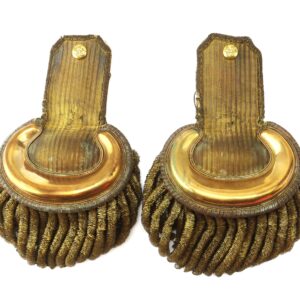
Pair of Civil War Lieutenant Colonel’s Shoulder Straps – 1st Potomac Home Brigade, Maryland
A fine matched pair of Union officer’s shoulder straps denoting the rank of Lieutenant Colonel, worn by Lt. Col. Steiner, a member of the 1st Potomac Home Brigade, Maryland Volunteers.
Each strap features a triple bullion border of false-embroidered gold wire, framing a dark blue field that signifies line officer service. The silvered oak leaf insignia remains crisply defined on both straps. The reverse retains the original buckram backing and remnants of the faded dark blue cloth underlay, secured with the period brass pins characteristic of wartime manufacture.
The triple-boarded false-embroidered shoulder straps is typical of mid- to late-war staff-grade insignia, showing excellent quality. The set exhibits light surface wear from use, but remains in solid condition with vibrant bullion and intact field cloth .
These straps are accompanied by a period tag noting: “Shoulder straps indicated that Steiner was a member of the regimental staff.”
An outstanding identified example of field-worn officer insignia from a Maryland regiment that served in both guard and combat duties in the defense of the Upper Potomac and during the Gettysburg Campaign.
Grouping of Maryland State Seal and Grand Army of the Republic Buttons of Lieutenant Colonel Steiner, 1st Maryland Potomac Home Brigade
Display containing a total of twenty-seven (27) gilt brass buttons belonging to Lieutenant Colonel Steiner of the 1st Maryland Potomac Home Brigade (Union service), neatly arranged on deep blue velvet within a protective museum style case.
Includes:
- (14) Coat-size Maryland State Seal buttons, each depicting the Maryland arms with farmer and fisherman supporters and the state motto “Fatti Maschii Parole Femine.”. Backmarked “EXTRA QUALITY.” – Directly from Steiner’s wartime uniform set.
- (3) U.S. General Service eagle buttons (coat size), standard Federal issue of the Civil War period.
- (10) Grand Army of the Republic (G.A.R.) veterans’ buttons—five coat size and five cuff size—each featuring the intertwined “G A R” monogram surmounted by a crown/star emblem, symbolizing Steiner’s postwar veteran affiliation.
Excellent overall, uniform gilt finish, sharp detail, and light age toning. Buttons are attractively mounted under glass in a 12” x 16” shadowbox display.
From the personal effects of Lieutenant Colonel Steiner, 1st Maryland Potomac Home Brigade, a distinguished Maryland officer whose service spanned the defense of the Union and later participation in the Grand Army of the Republic.
Model 1850 Staff & Field Officer’s Sword of Lieutenant Colonel James A. Steiner, 1st Maryland Potomac Home Brigade
An exceptional Model 1850 Staff and Field Officer’s sword belonging to Lieutenant Colonel James A. Steiner, 1st Maryland Potomac Home Brigade. This high-quality officer’s grade example is retailed by W.H. Horstmann & Sons, Philadelphia, and bears their etched retailer’s panel on the blade. The reverse ricasso is stamped “IRON PROOF” on the spine — indicating German manufacture.
The brass guard is of fine quality, deeply cast and chased with floral motifs and the bold openwork “U.S.” within a foliate design. The grip retains its original sharkskin wrap and twisted brass wire binding, showing only light wear.
The blade is etched with classic Horstmann patriotic motifs including scrollwork, panoplies of arms, and the spread-wing American eagle. The top scabbard mount is inscribed in script “J.A.S. / 1861”, the same manner in which Steiner inscribed both his wartime diary and the ivory grip of his revolver, confirming personal identification.
Fine overall. Blade retains traces of original frosting with areas of age toning and light oxidation. Hilt and mounts retain a pleasing patinated brass surface. Scabbard shows typical handling wear and undisturbed, period patina.
Provenance: From the personal effects of Lieutenant Colonel James A. Steiner, 1st Maryland Potomac Home Brigade. Steiner served with distinction in the defense of Maryland and in operations along the Potomac River. This sword is of “much finer quality than those issued by the U.S. Army”, as noted in period documentation.
Copper Printing Plate – 1st Maryland Potomac Home Brigade – Original 19th-century regimental roster plate.
This rare copper (or copper-faced electrotype) printing plate was created for the publication of the Roster of the 1st Maryland Potomac Home Brigade Infantry. The plate is engraved in reverse (mirror image) so that, when inked and pressed to paper, it would print correctly in readable form.
The text lists individual soldiers alphabetically—such as Singleton Albauch, John Alsop, Daniel Ambrose, Jeremiah Andrews, and others—alongside their rank (Private), date of enlistment, muster dates, discharge information, and remarks such as “Transferred to Company E, Infantry” or “Died May 21, 1862.”
The top line identifies the source: “Roster — Company A, First Regiment Potomac Home Brigade Infantry.”
These plates were part of the typesetting and proofing process for Maryland’s Adjutant General’s annual reports or other regimental histories compiled in the late 19th century to record Civil War service. Each column represents a different data field, and the precise spacing and uniform font demonstrate the careful craftsmanship of period printers.
Pair of Civil War .58 Caliber “Minie Ball” Projectiles
Recovered examples of the standard three-ring .58 caliber conical lead bullet used by Union forces during the Civil War. Each exhibits typical battlefield oxidation and patina—one light gray-white, the other darker from soil contact. These “Minie balls” were among the most common projectiles fired from Springfield and Enfield rifled muskets throughout the war.
This pair was brought home by Lieutenant Colonel James A. Steiner of the 1st Maryland (Potomac Home) Brigade, part of his personal wartime collection retained as souvenirs from the field.
Set of Casey’s Infantry Tactics Volumes Belonging to Lt. Col. James A. Steiner – By Authority of the War Department, August 1862. Published by D. Van Nostrand, New York
This complete three-volume set of “Casey’s Infantry Tactics” (Volumes I–III) represents one of the cornerstone manuals of Union military training and instruction during the American Civil War. Authored by Brigadier General Silas Casey, U.S. Army, these texts were the official standard for drill and field maneuver for volunteer and regular infantry regiments beginning in 1862.
This grouping bears direct connection to Lieutenant Colonel James A. Steiner of the 1st Maryland (Potomac Home) Brigade, whose personal signature in bold period ink appears on the inside flyleaves of Volumes I and III, each dated “Feby 1863.” The penmanship is consistent with other authenticated examples from his wartime diary and inscribed sword grip. Volume II lacks its flyleaf, suggesting it was likely acquired separately to complete the set, though it remains the proper 1862 edition by Van Nostrand with matching gilt-embossed spine and Federal eagle device.
The trio retains their original dark blue cloth bindings with gilt titles reading “CASEY’S INFANTRY TACTICS / BY AUTHORITY AUG. 1862 / Van Nostrand, New York”, and shows honest age and use consistent with field handling. These were the same manuals issued to and carried by officers in active service, covering instruction from the school of the soldier through battalion evolutions and skirmishing.
1/6 Plate Daguerreotype of Mrs. James A. Steiner, Wife of Lt. Col. James A. Steiner, 1st Maryland Potomac Home Brigade
Housed in its original thermoplastic and leatherette case with gilt oval mat and plush red velvet liner. The image depicts Mrs. Steiner seated in a three-quarter pose, wearing a fine silk dress with lace cuffs and a white bonnet tied under her chin with a broad ribbon. The plate retains subtle hand-tinting to her cheeks and gown.
In her right hand she holds what appears to be a small bird or floral bouquet—visible close examination suggests fine feathery texture, possibly a keepsake arrangement incorporating feathers or hair, a popular sentimental motif in early-Victorian portraiture. Opposite the image, nestled in the case’s velvet pad, is a delicate circular wreath of dried flowers, likely contemporary to the photograph and possibly the same arrangement she is shown holding—serving as a poignant mourning or remembrance token.
Dating from circa 1848–1853, this portrait was almost certainly taken prior to or at the onset of her husband’s long public service career in Frederick, Maryland.
1/4 Plate Daguerreotype of Lt. Col. James A. Steiner’s Parents, Circa 1845–1855
This fine early 1/4 plate daguerreotype depicts the parents of Lieutenant Colonel James A. Steiner, commanding officer of the 1st Maryland (Potomac Home) Brigade during the Civil War. The seated couple is posed in a classic mid-19th-century studio setting, the father attired in a formal dark suit with waistcoat and bow tie, while the mother wears a dark dress with lace collar and white cap. Both are captured with the characteristic clarity and reflective depth unique to daguerreotypes.
The image remains housed in its original ornate gilt mat and leather case, with a period identification label affixed below the plate reading “STEINER’S PARENTS.” The presence of this early family portrait provides an intimate connection to the lineage of Lt. Col. Steiner.
The Battle of Gettysburg — Personal Copy from the Steiner Family, By Jesse Bowman Young. New York: The Neale Publishing Company, 1913.
This handsome early 20th-century volume, The Battle of Gettysburg by Jesse Bowman Young, was the personal copy of the Steiner family, descendants of Lieutenant Colonel James A. Steiner, commanding officer of the 1st Maryland (Potomac Home) Brigade. The book is bound in its original dark blue cloth with gilt spine and cover lettering and features crossed sabers beneath the title.
Inside the front flyleaf appears a period pencil notation reading “See pp. 412”, directing attention to a passage that references the 1st Maryland, Potomac Home Brigade, commanded by Colonel William P. Maulsby, with heavy losses at Gettysburg (104 casualties). In the margin of that same page, a penciled note — “JAS 1 MD” Referring to James A. Steiner and his regiment’s role in the battle.
The front endpaper also bears the ink ownership stamp: “Property of Edward E. Steiner, Baltimore, Md.”. Likely the son of Lieutenant Colonel Steiner.
Original Civil War Officer’s Sword Belt of Lieutenant Colonel James A. Steiner, also used by him in the G.A.R. as a Veteran.
A fine original wartime leather sword belt made of black patent leather, exhibiting the classic form used by Union officers during the Civil War. The belt retains one original sword hanger, with the second now absent from age or use. The gilt brass plate currently affixed is a Grand Army of the Republic (GAR) veteran’s buckle, which was added in the postwar era, likely by Lieutenant Colonel James A. Steiner himself to continue wearing his original belt at veteran reunions and commemorative events.
The belt shows light surface crazing consistent with age, with stitching intact and the brass hook and suspension strap showing minor oxidation. The presence of the GAR buckle—a distinctive postwar addition—offers a fascinating transitional artifact illustrating how Civil War veterans adapted and reused their wartime accoutrements for ceremonial use after the conflict.
Cabinet Card Photograph of the 1st Maryland Potomac Home Brigade Monument at Gettysburg – By W. H. Tipton, Gettysburg, Pennsylvania – ca. 1890–1895.
Original albumen photograph mounted on beveled green card stock, gilt-lettered along the lower margin “W. H. Tipton, Gettysburg, Pa.” Depicts the 1st Maryland Regiment, Potomac Home Brigade, Volunteer Infantry Monument situated on Culp’s Hill at Gettysburg. The monument inscription reads:
“1st Maryland Regiment Potomac Home Brigade, Vol. Infantry, Col. Wm. P. Maulsby, Lockwood’s Independent Brigade, 12th Corps. Maryland’s Tribute to Her Loyal Sons.”
The monument was dedicated November 13, 1884, honoring the Maryland volunteers who fought in Lockwood’s Brigade during the defense of Culp’s Hill on July 2–3, 1863. The regiment served with distinction throughout the Maryland campaigns and was among the few Union units representing a border state divided by the war.
Photographed by William H. Tipton, noted Gettysburg photographer and battlefield chronicler, whose documentation of the monuments erected in the 1880s–1890s remains one of the most complete visual records of the national cemetery and surrounding fields.
Pair of Postwar Cabinet Card Portraits of General James A. Steiner and His Wife, By Perkins, 103 W. Baltimore Street, Baltimore, Maryland – ca. 1875–1885
Two original cabinet card albumen photographs by the Baltimore photographer Perkins, both mounted on typical studio card stock with imprinted photographer’s credit along the lower margin.
The first depicts General James A. Steiner, late Lieutenant Colonel of the 1st Maryland Potomac Home Brigade Infantry, shown in civilian attire during his later years. The reverse bears a bold period ink inscription reading “Gen. Jno. A. Steiner”, identifying the sitter. Additional pencil notations, including a numbering sequence, suggest organization for a family or veterans’ photographic album.
The second image portrays Mrs. Steiner in her later years, wearing a dark dress with lace collar and earrings, likewise on a Perkins studio mount. The reverse bears the same style of penciled number, linking it unmistakably as part of the Steiner family collection.
Steiner’s postwar title of “General” reflects his later service in the Maryland militia and his leadership in veterans’ affairs following the Civil War. Both portraits were taken in Baltimore, where the family resided after the war.
Hand-Colored Salt Print Portrait of Lt. Col. James A. Steiner, 1st Maryland Potomac Home Brigade
Fine original hand-colored salt-print photograph of Lt. Col. James A. Steiner, shown standing in full uniform holding his sword. The image likely dates to circa 1863–64, when Steiner held the rank of Major, prior to his promotion to Lieutenant Colonel. The portrait is attractively mounted in its period oval mat within a burl and inlaid walnut frame, retaining the original gilt liner and early wavy glass.
Steiner is depicted wearing the double-breasted frock coat, sword belt, sash, and gilt staff buttons that survive in this grouping, making this portrait a definitive visual record of his wartime appearance. The photograph is lightly tinted in watercolor tones of blue-gray and gold, enhancing the detail of his uniform and sword hilt.
This image is among the earliest and most personal surviving likenesses of Lt. Col. James A. Steiner, commanding officer of the 1st Maryland Potomac Home Brigade, a regiment that served with distinction and fought at Gettysburg.
Pair of Wartime Diaries of Lt. Col. James A. Steiner — 1864 & 1865 Campaigns – 1st Maryland Potomac Home Brigade
An extraordinary pair of Civil War diaries kept by Lt. Col. James A. Steiner, commanding officer of the 1st Maryland Potomac Home Brigade, spanning the climactic final years of the war. Bound in their original black Morocco leather covers, each embossed “Diary 1864” and “Diary 1865” in gilt, the volumes remain in excellent condition with strong bindings and clean pages. The inner flap of the 1865 diary is boldly inscribed in Steiner’s hand: “J. A. Steiner / Fred’k Md / 1865.”
Both volumes contain voluminous daily entries from cover to cover, documenting field operations, military life, and momentous national events. Steiner’s notes chronicle the final campaigns of the war, the surrender of Confederate forces, and the assassination of Abraham Lincoln, all from the perspective of a veteran Maryland officer whose command saw service in the defense of the Capital and in the Shenandoah. The entries also reference his administrative duties and later service as Sheriff of Frederick City, providing a rare first-hand link between Maryland’s wartime and Reconstruction eras.
Following the Gettysburg campaign, Steiner resigned his commission but remained a respected figure in Frederick. His diaries capture the personal reflections, battlefield observations, and civic awareness of a Union officer witnessing the nation’s rebirth. Together, these meticulously kept journals constitute one of the most complete and evocative surviving manuscript records associated with the 1st Maryland Potomac Home Brigade and its distinguished commander.
Officer’s Sword Sash of Lt. Col. James A. Steiner, 1st Maryland Potomac Home Brigade
An original Civil War officer’s sword sash belonging to Lt. Col. James A. Steiner, 1st Maryland Potomac Home Brigade. The sash is of maroon worsted wool with heavy braided cords and large tassels, measuring of typical field length and retaining its full original form. Though maroon worsted wool was the regulation pattern for non-commissioned officers, this example was privately acquired and personally worn by Steiner throughout his wartime service, rather than the more expensive crimson silk variety favored by staff officers.
The piece remains in excellent condition, showing minimal fray and strong color retention, with the deep red hue characteristic of mid-war manufacture. The texture and construction are consistent with known examples produced by Philadelphia military outfitters.
Leather Wallet of Lt. Col. James A. Steiner, 1st Maryland Potomac Home Brigade
Fine original Civil War–era leather billfold wallet belonging to Lt. Col. James A. Steiner of Frederick, Maryland, commanding officer of the 1st Maryland Potomac Home Brigade. Constructed of high-quality black Moroccan leather with gilt-embossed border trim, the wallet features a fold-over flap closure and interior pockets designed for correspondence, currency, or small papers.
The interior retains its original paper memorandum pad with distinctive yellow covers, likely used for notes and field memoranda. The lining exhibits natural wear from period use, yet remains structurally sound and complete. The elegant design and quality of workmanship suggest private purchase from a Washington or Baltimore outfitter catering to officers.
Field Manual for Battalion Drill by Capt. Henry Coppée — Inscribed to Lt. Col. James A. Steiner, 1st Maryland Potomac Home Brigade – Philadelphia: J. B. Lippincott & Co., 1863
Original wartime copy of The Field Manual for Battalion Drill, by Capt. Henry Coppée, late instructor at the U.S. Military Academy, West Point, published in Philadelphia in 1863. The volume is inscribed in ink on the title page and front endleaf by Lt. Col. James A. Steiner, reading: “J.A. Steiner / 1st Md. Regt. P.H.B. Vols / Balto. June 1863.”
This manual was among the standard instructional works used by Union officers for company and battalion-level maneuvers, adapted from the latest French military systems. Steiner’s inscription places the book in Baltimore during mid-1863, just weeks before the Gettysburg Campaign, when his regiment—the 1st Maryland Potomac Home Brigade—was actively engaged in the defense of Maryland and Pennsylvania.
Bound in its original embossed blue cloth with the U.S. shield and eagle motif on the cover, the volume remains in fine condition.
Inventory Number: GET 538



Reviews
There are no reviews yet.