
Lone Mountain, Georgia – Great Content Letter
$395.00
Description
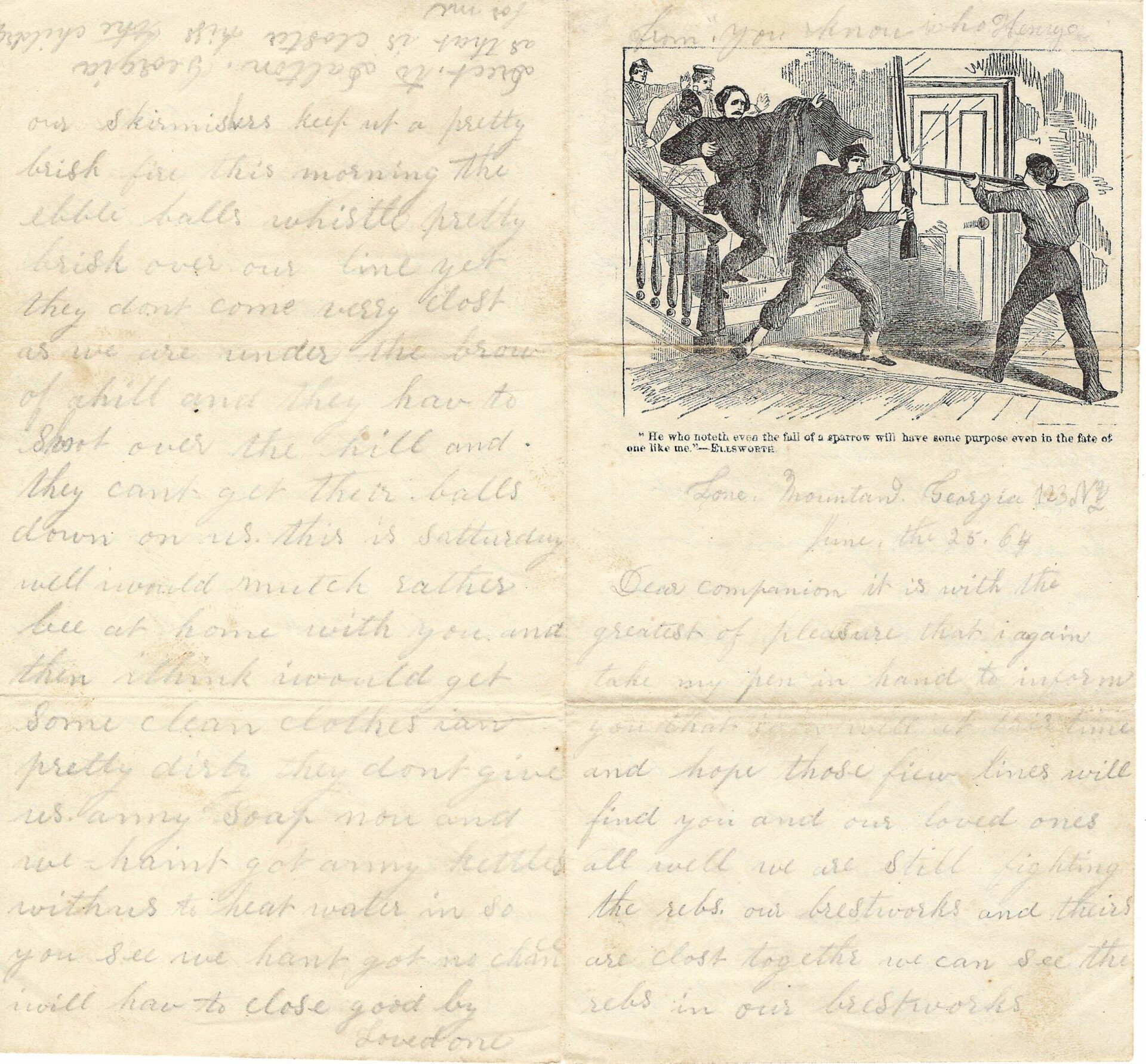
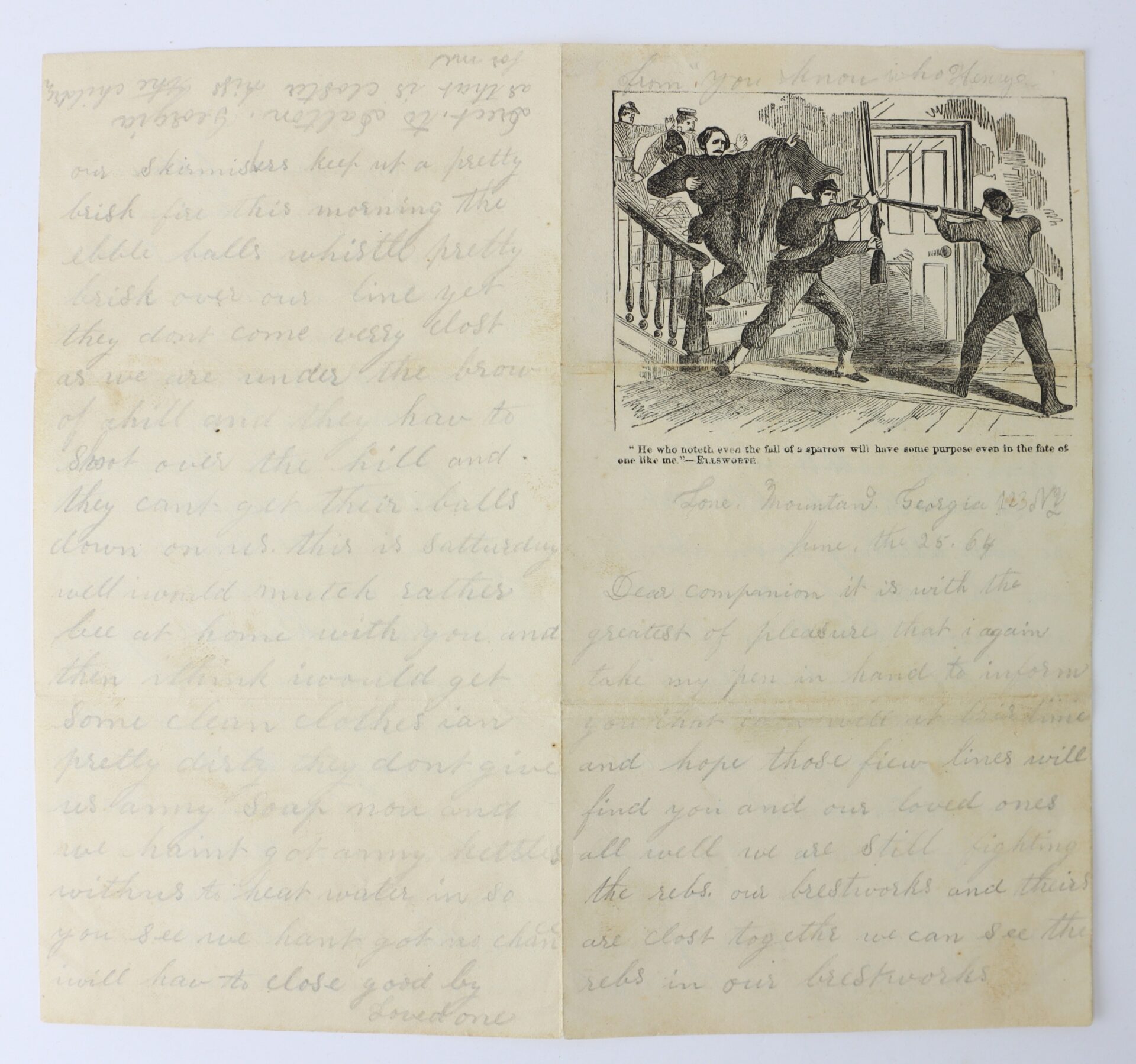
Lone Mountain, Georgia Letter
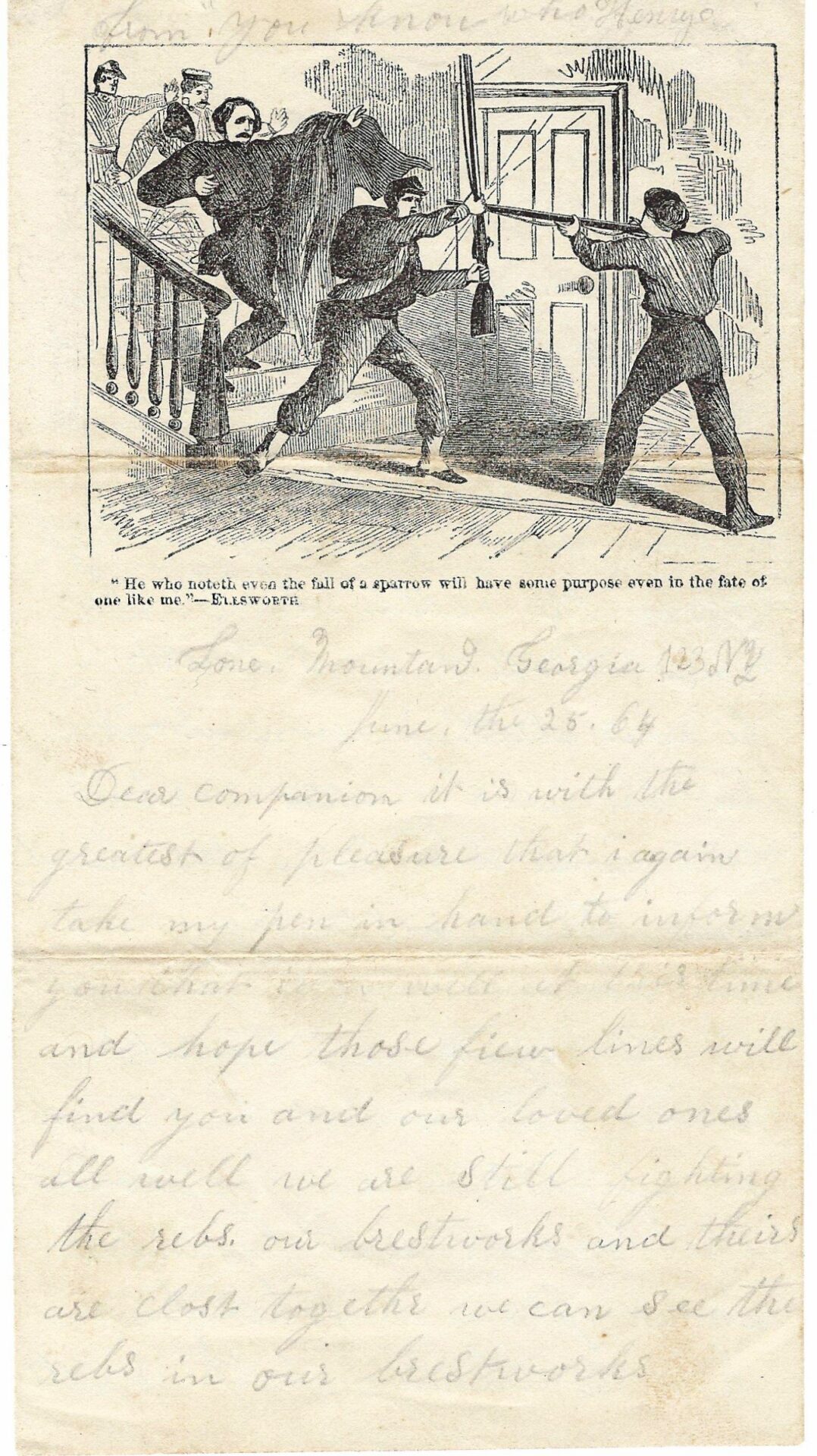
Lone Mountain, Georgia
June the 25th/64
123 N.Y.
Dear Companion
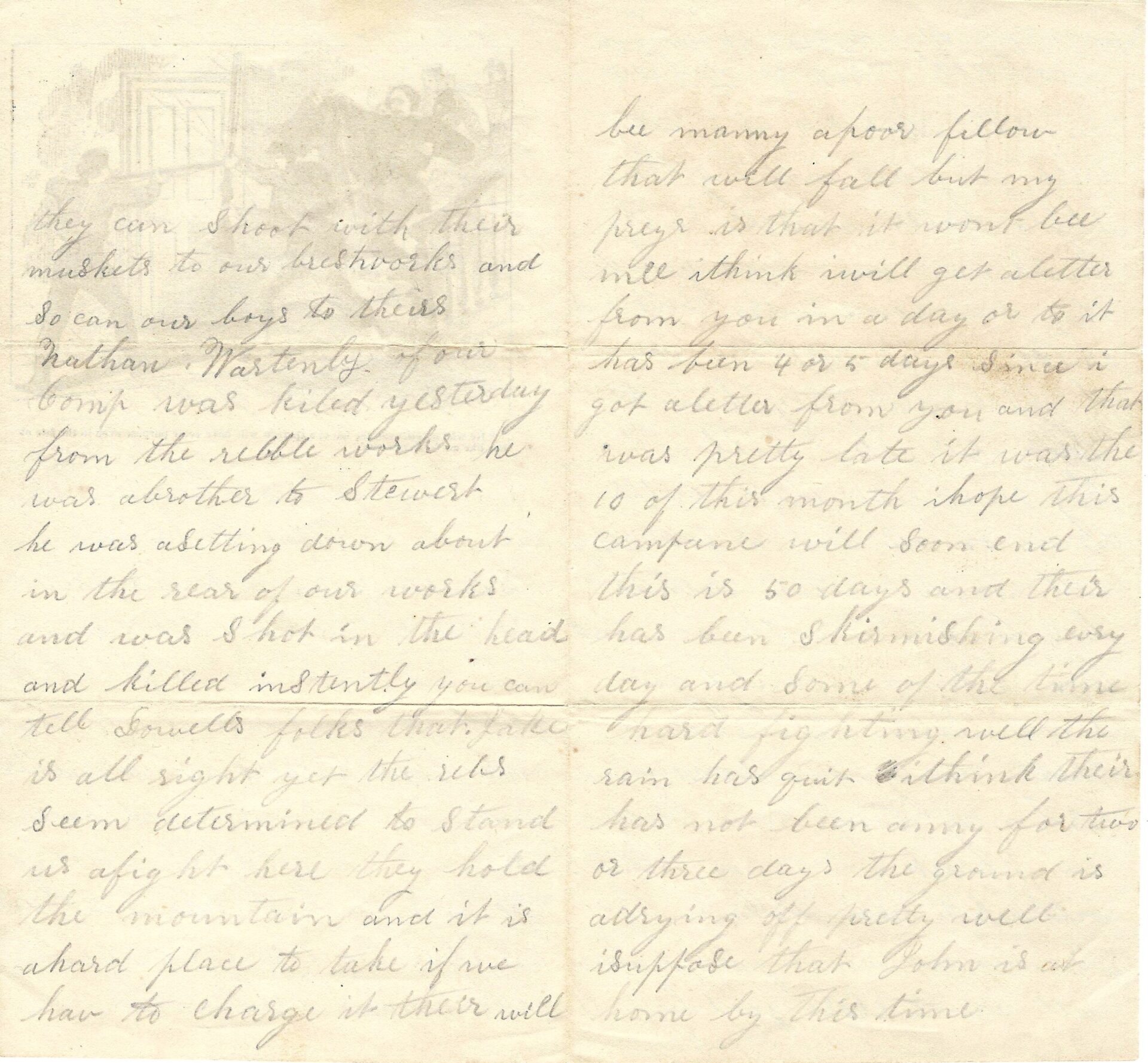
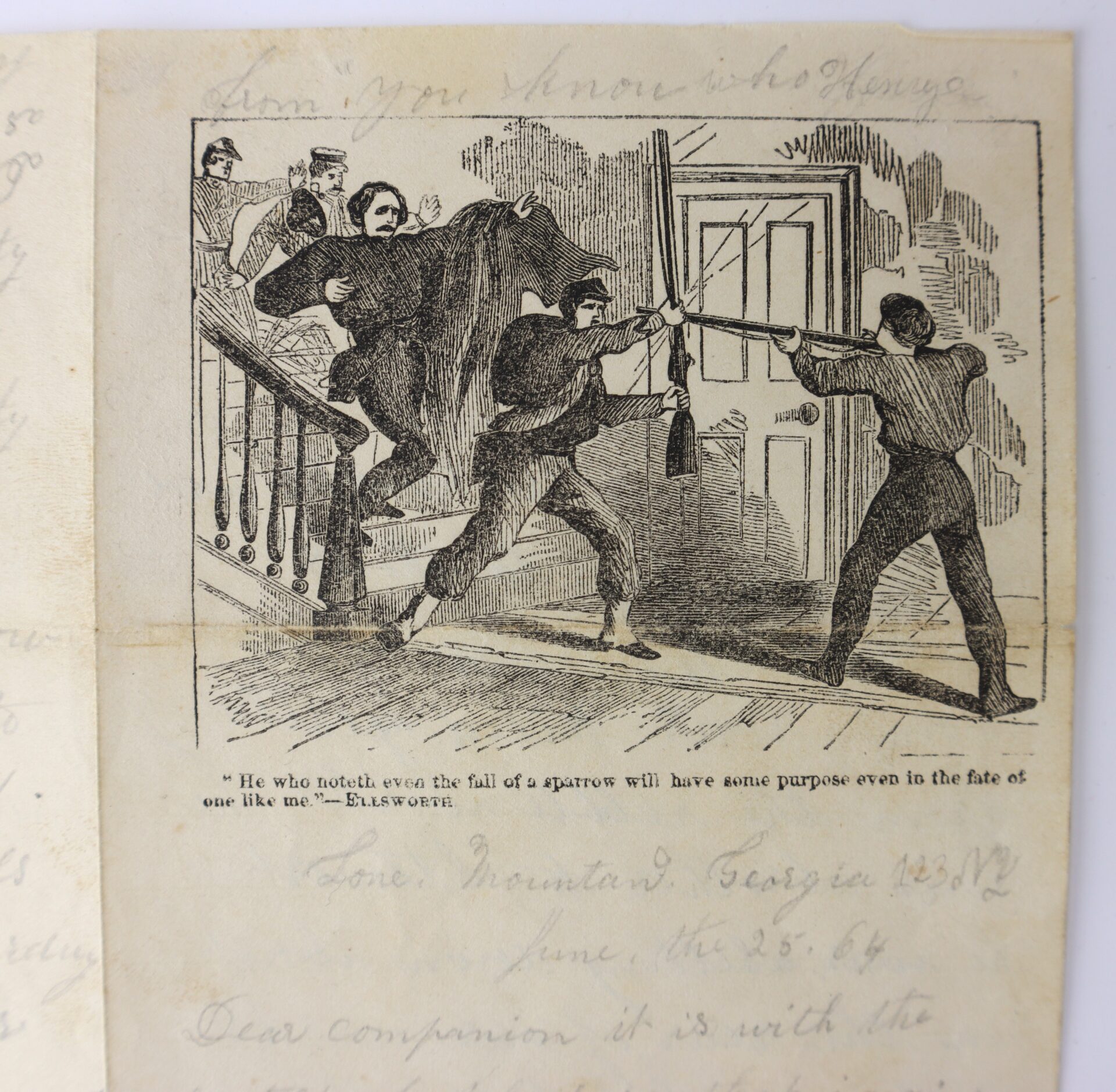
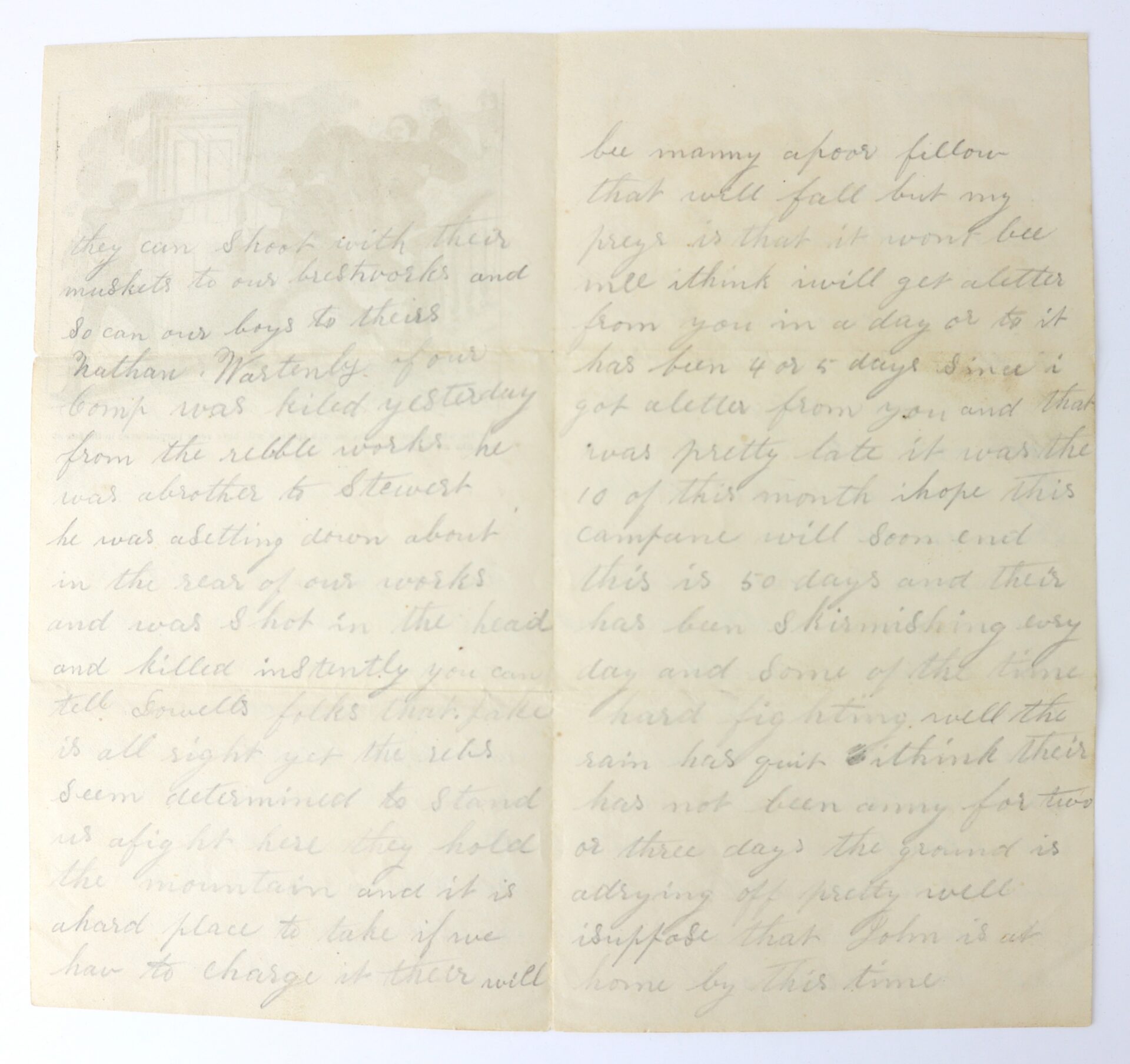
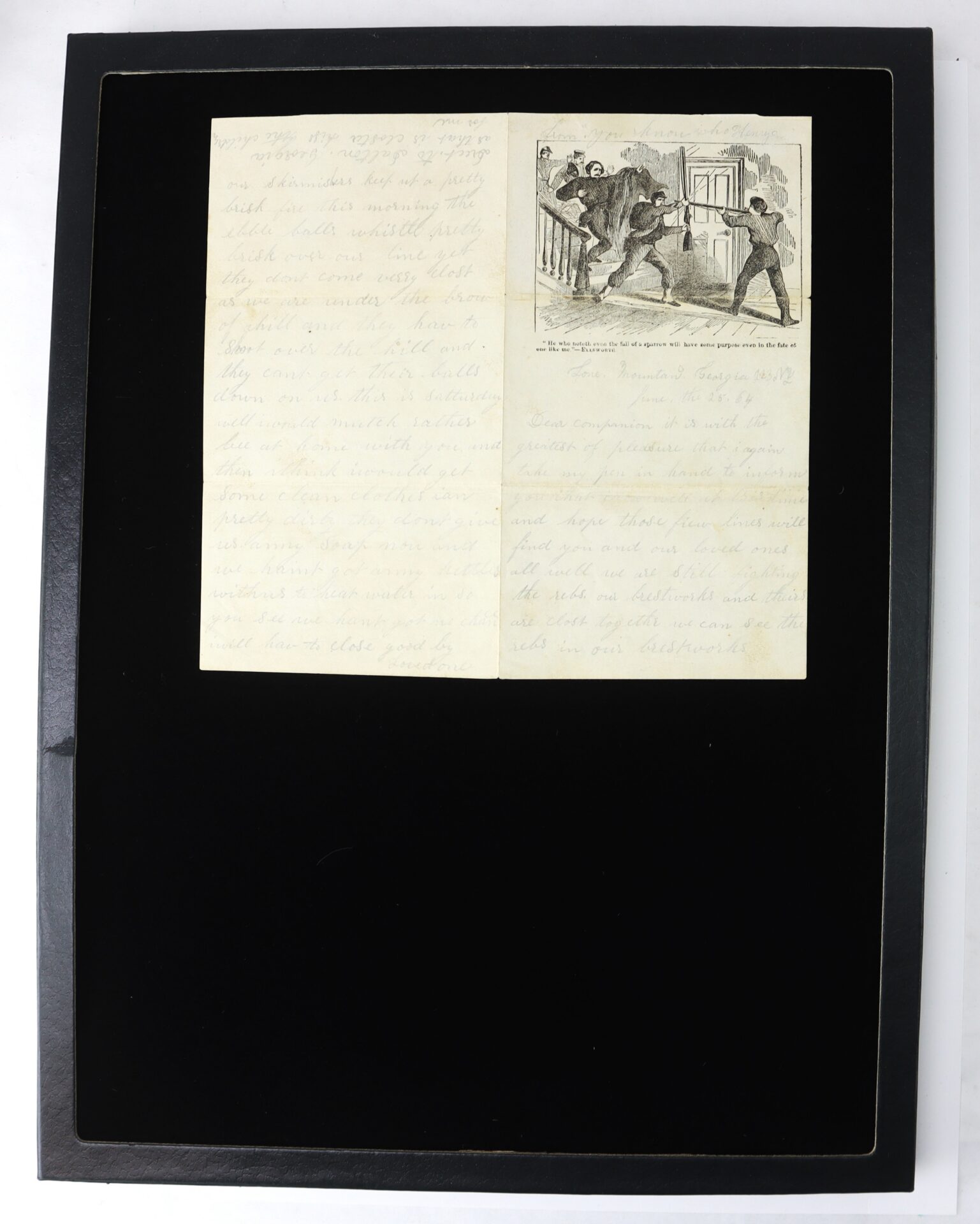
…We are still fighting the rebs. Our breastworks and theirs are close together. We can see the rebs in our breastworks. They can shoot with their muskets at our breastworks and so can our boys to theirs. Nathan Wartenby of our company was killed yesterday from the rebel works. He was a brother to Stewart. He was setting down about in the rear of our works and was shot in the head and killed instantly…The rebs seem determined to stand us a fight here. They hold the mountain and it is a hard place to take if we have to charge it. There will be many a poor fellow that will fall, but my prayer is that it won’t be…I hope that this campaign will soon end. This is fifty days and there has been skirmishing every day and some of the time hard fighting…Our skirmishers keep up a pretty brisk fire this morning. The rebel balls whistled pretty brisk over our line, yet they dont come very close as we are under the brow of a hill and they have to shoot over the hill and they cant get their musket balls down on us….I would much rather be at home with you…I am pretty dirty. They dont give us any soap…I will have to close. Good bye loved one. Direct to Fulton, Georgia as that is the closest. Kiss the children for me.
From “You Know Ho”
Henry
The 123rd New York Volunteer Infantry—known as the “Washington County Regiment”—served with the 20th Corps in the Army of the Cumberland during the Atlanta Campaign of 1864. By June 1864 the regiment was deeply engaged in the grinding operations against Confederate General Joseph E. Johnston’s defensive positions around Kennesaw Mountain, Georgia.
The letter here, dated June 25, 1864 from “Lone Mountain, Georgia,” was written during one of the most dangerous phases of the campaign. “Lone Mountain” was a contemporary soldier reference to the rugged terrain near Lost Mountain and the Kennesaw line west of Marietta. Union and Confederate forces were entrenched at extremely close range, exactly as described in the letter. Soldiers often fought from opposing breastworks separated by only a short distance, with constant sharpshooting and skirmishing throughout the day.
The 123rd New York had already endured hard campaigning through Tennessee and northern Georgia before reaching these lines. During the Atlanta Campaign, the regiment participated in operations at Resaca, Cassville, New Hope Church, Pine Mountain, Golgotha Church, and the Kennesaw Mountain sector. By late June, the men were exhausted from nearly two months of continuous marching, digging entrenchments, and near-daily combat. The writer’s statement that “This is fifty days and there has been skirmishing every day and some of the time hard fighting” accurately reflects the brutal reality of Sherman’s advance toward Atlanta.
On June 25–27, Union forces probed and pressured the Confederate mountain defenses in preparation for the major assault at Kennesaw Mountain on June 27, 1864. The terrain was notoriously difficult. Confederates occupied elevated ridges and mountain slopes protected by artillery and fortified trenches. Federal troops advancing against those heights faced deadly fire, which explains the writer’s fear that “many a poor fellow” would fall if ordered to charge the position.
The mention of Nathan Wartenby being killed while behind the works illustrates another grim reality of the campaign: soldiers were vulnerable even in supposedly protected positions. Sharpshooters and random musket fire constantly swept the lines, and casualties occurred daily from men exposing themselves above the parapets or simply being unlucky enough to be struck by a stray ball.
The 123rd New York remained with Sherman through the fall of Atlanta and later marched in Sherman’s Carolinas Campaign. The regiment was mustered out in June 1865 after nearly three years of hard service. Today, letters such as this are prized for their vivid first-person descriptions of trench warfare in the Atlanta Campaign—combat that increasingly foreshadowed the static, entrenched warfare later seen on a massive scale during World War I.
Inventory Number: DOC 425
Related products
-

Mid-19th Century Historical Figural Flask – Washington/Taylor Portrait Flask
$250.00 Add to cart -
Civil War-Era Union Smoothside Canteen with Original Cover and Strap
$395.00 Add to cart -
Check Signed by Civil War Photographer Alexander Gardner
$950.00 Add to cart -
Vote the Land of the Free Kansas Statehood Token
$395.00 Add to cart


Reviews
There are no reviews yet.