
The Dying Soldier’s Message By the Hon. Mrs. Norton
$165.00
Description
The Dying Soldier’s Message
By the Hon. Mrs. Norton
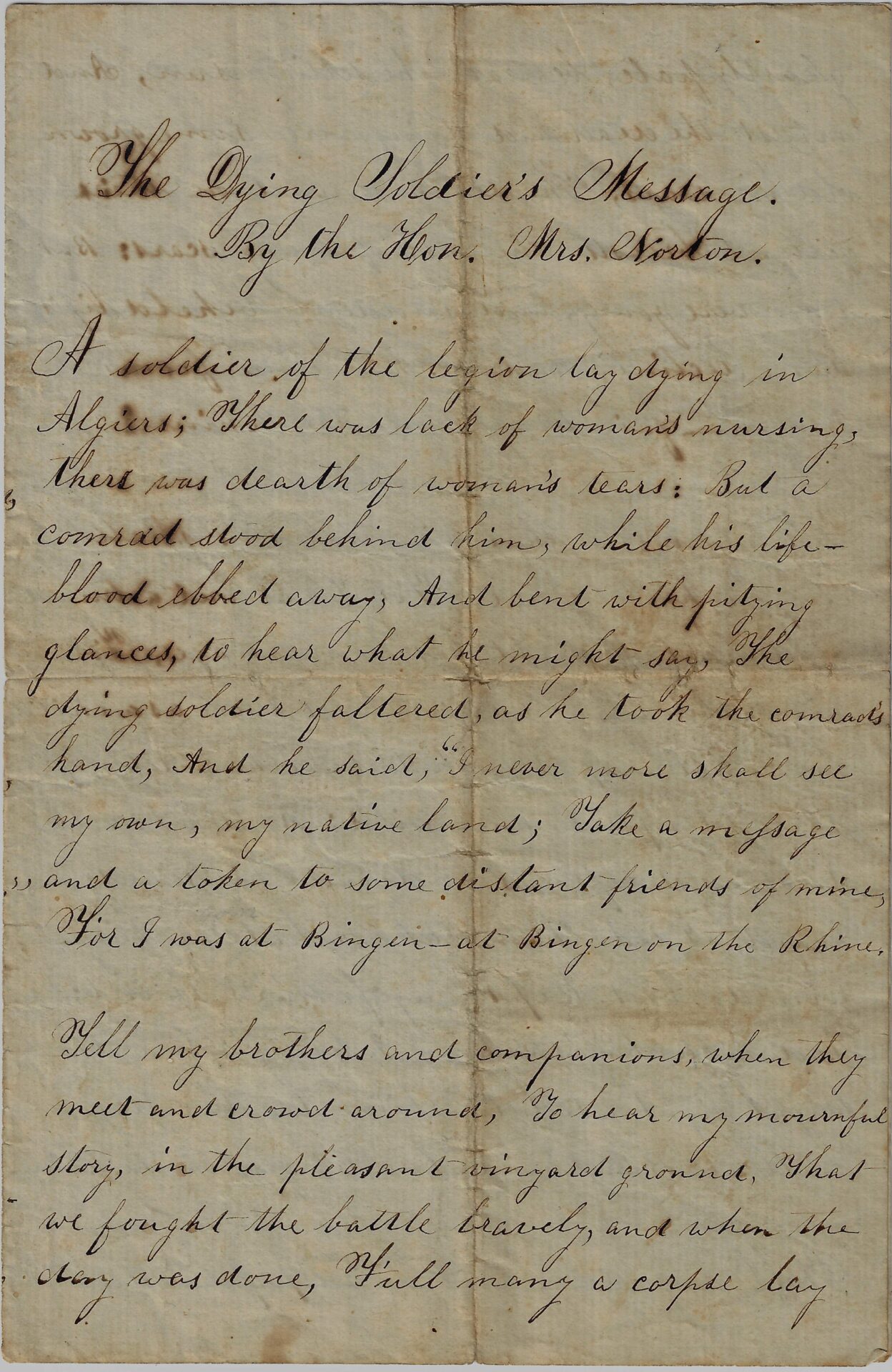
A soldier of the legion lay dying in Algiers; where was lack of woman’s nursing, there was dearth of woman’s tears; but a comrade stood beside him, while his life-blood ebbed away, and bent with pitying glances, to hear what he might say. The dying soldier faltered, as he took the comrade’s hand, and he said, “I never more shall see my own, my native land; take a message and a token to some distant friends of mine, for I was at Bingen—at Bingen on the Rhine.
Tell my brothers and companions, when they meet and crowd around, to hear my mournful story in the pleasant vineyard ground, that we fought the battle bravely, and when the day was done, full many a corpse lay…”
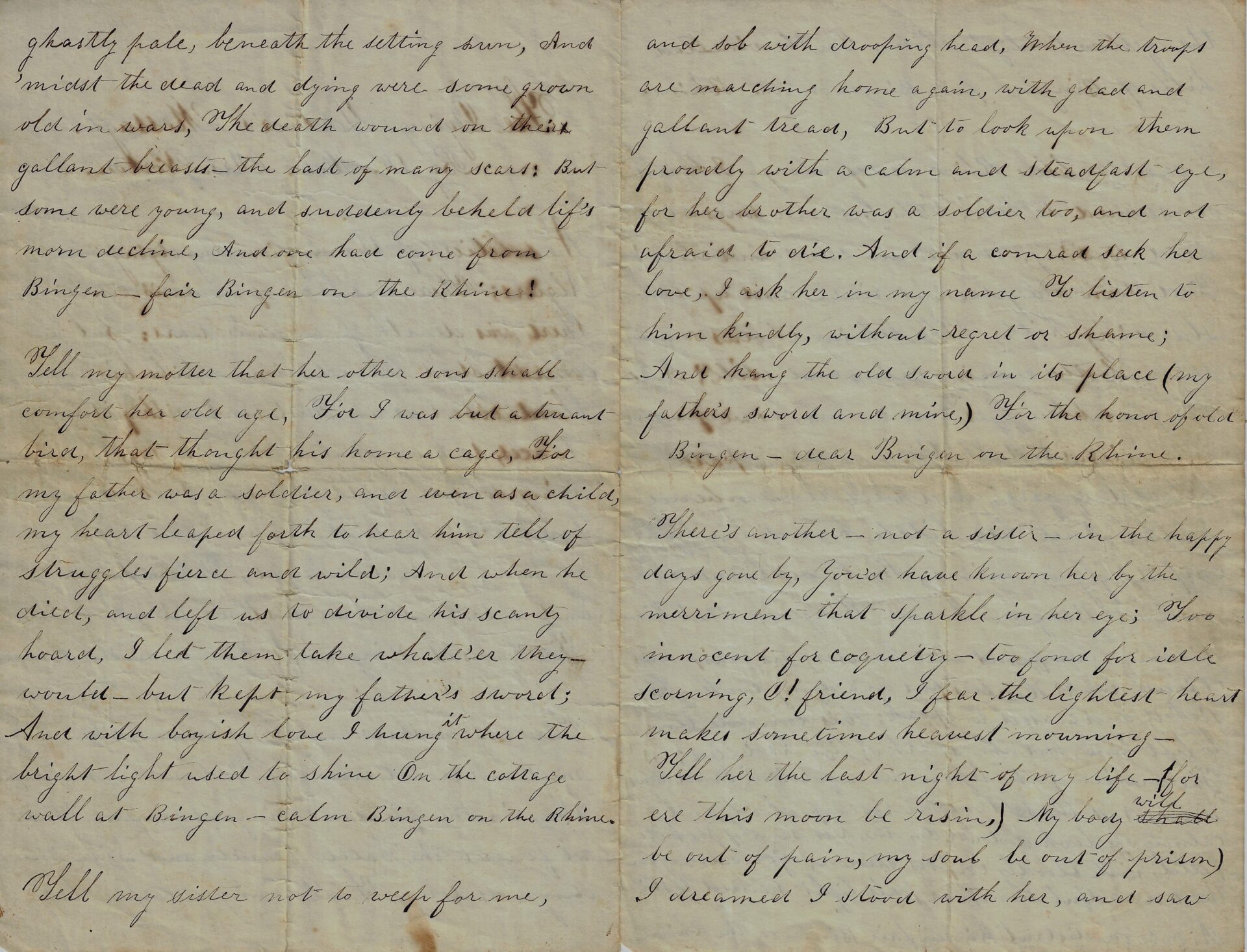
…and sob with drooping head, when the troops are marching home again, with glad and gallant tread; but to look upon them proudly with a calm and steadfast eye, for her brother was a soldier too, and not afraid to die. And if a comrade seek her love, I ask her in my name to listen to him kindly, without regret or shame; and hang the old sword in its place (my father’s sword and mine), for the honor of old Bingen—dear Bingen on the Rhine.
There’s another—not a sister—in the happy days gone by, you’d have known her by the merriment that sparkled in her eye; too innocent for coquetry—too fond for idle scorning; oh friend, I fear the lightest heart makes sometimes heaviest mourning. Tell her the last night of my life (for ere this moon be risen, my body will be out of pain, my soul be out of prison), I dreamed I stood with her, and saw…
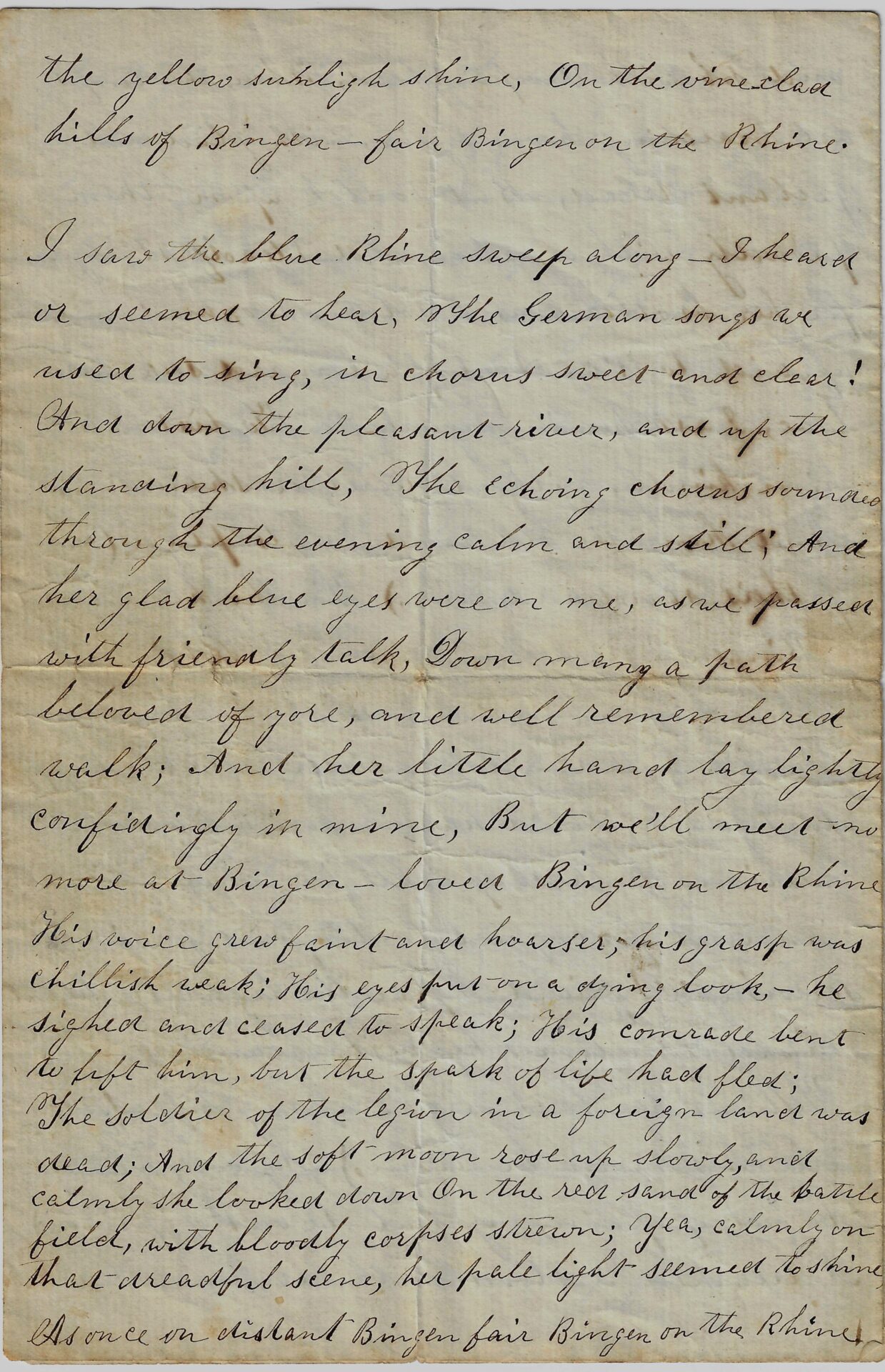
…the yellow sunlight shine on the vine-clad hills of Bingen—fair Bingen on the Rhine. I saw the blue Rhine sweep along—I heard, or seemed to hear, the German songs we used to sing, in chorus sweet and clear; and down the pleasant river, and up the slanting hill, the echoing chorus sounded through the evening calm and still; and her glad blue eyes were on me, as we passed with friendly talk, down many a path beloved of yore, and well remembered walk; and her little hand lay lightly, confidingly in mine, but we’ll meet no more at Bingen—loved Bingen on the Rhine.
His voice grew faint and hoarser, his grasp was childish weak; his eyes put on a dying look—he sighed and ceased to speak; his comrade bent to lift him, but the spark of life had fled; the soldier of the legion in a foreign land was dead. And the soft moon rose up slowly, and calmly she looked down on the red sands of the battle-field, with bloody corpses strewn; yea, calmly on that dreadful scene, her pale light seemed to shine, as once on distant Bingen—fair Bingen on the Rhine.
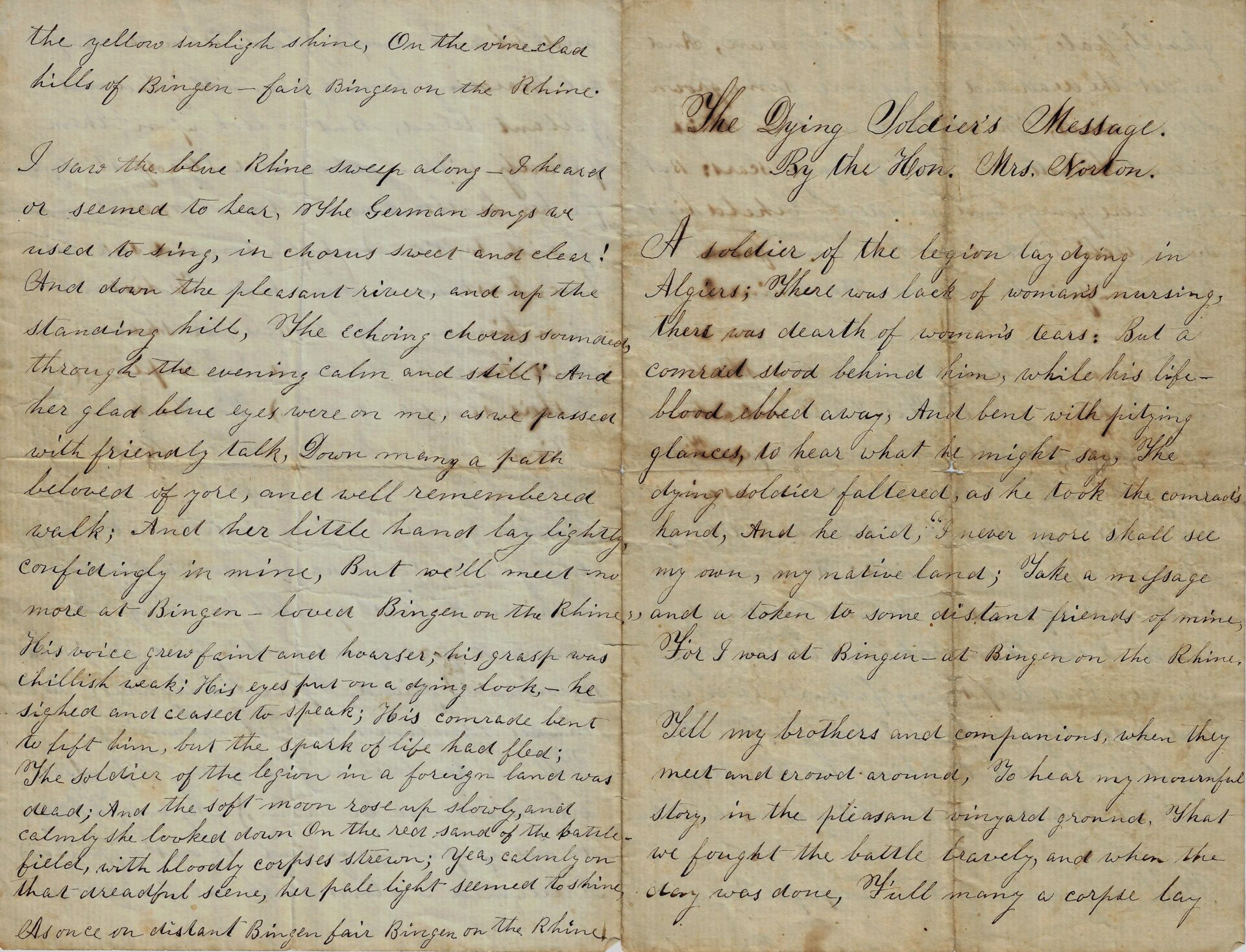
A compelling handwritten period copy of “The Dying Soldier’s Message,” a widely circulated 19th-century sentimental war poem by Caroline Norton, here carefully transcribed in ink across multiple folded sheets. The hand is fluid and confident, likely mid-19th century, with strong period cursive and consistent spacing, suggesting either a practiced clerk or an educated civilian copying a popular and emotionally resonant piece.
The poem itself—better known in published form as “Bingen on the Rhine”—was immensely popular during the Civil War era, frequently copied into letters, journals, and personal keepsakes. Its themes of battlefield death, comradeship, memory, and longing for home resonated deeply with soldiers and families alike, making manuscript examples such as this highly desirable within the field.
Physically, the piece shows expected age: fold lines from repeated handling, light toning, and scattered staining consistent with period paper. The multi-page format and complete narrative arc indicate this was not a fragment but a deliberate and intact transcription, likely intended for sharing, recitation, or personal reflection.
An excellent example of wartime or near-wartime literary culture—capturing not only the text of a beloved poem, but the human impulse to preserve and circulate it by hand.
Inventory Number: DOC 419
Related products
-

Check Signed by Civil War Photographer Alexander Gardner
$950.00 Add to cart -
Civil War-Era Union Smoothside Canteen with Original Cover and Strap
$395.00 Add to cart -
Cased Shoehorn and Button Hook of William “Extra Billy” Smith
$550.00 Add to cart -
Original Gatling Gun Pamphlet and Photographs
$950.00 Add to cart


Reviews
There are no reviews yet.