
Officer’s Commission – Army of the American Eagle, Chicago, April 26, 1865
$150.00
Description
Officer’s Commission – Army of the American Eagle, Chicago, April 26, 1865
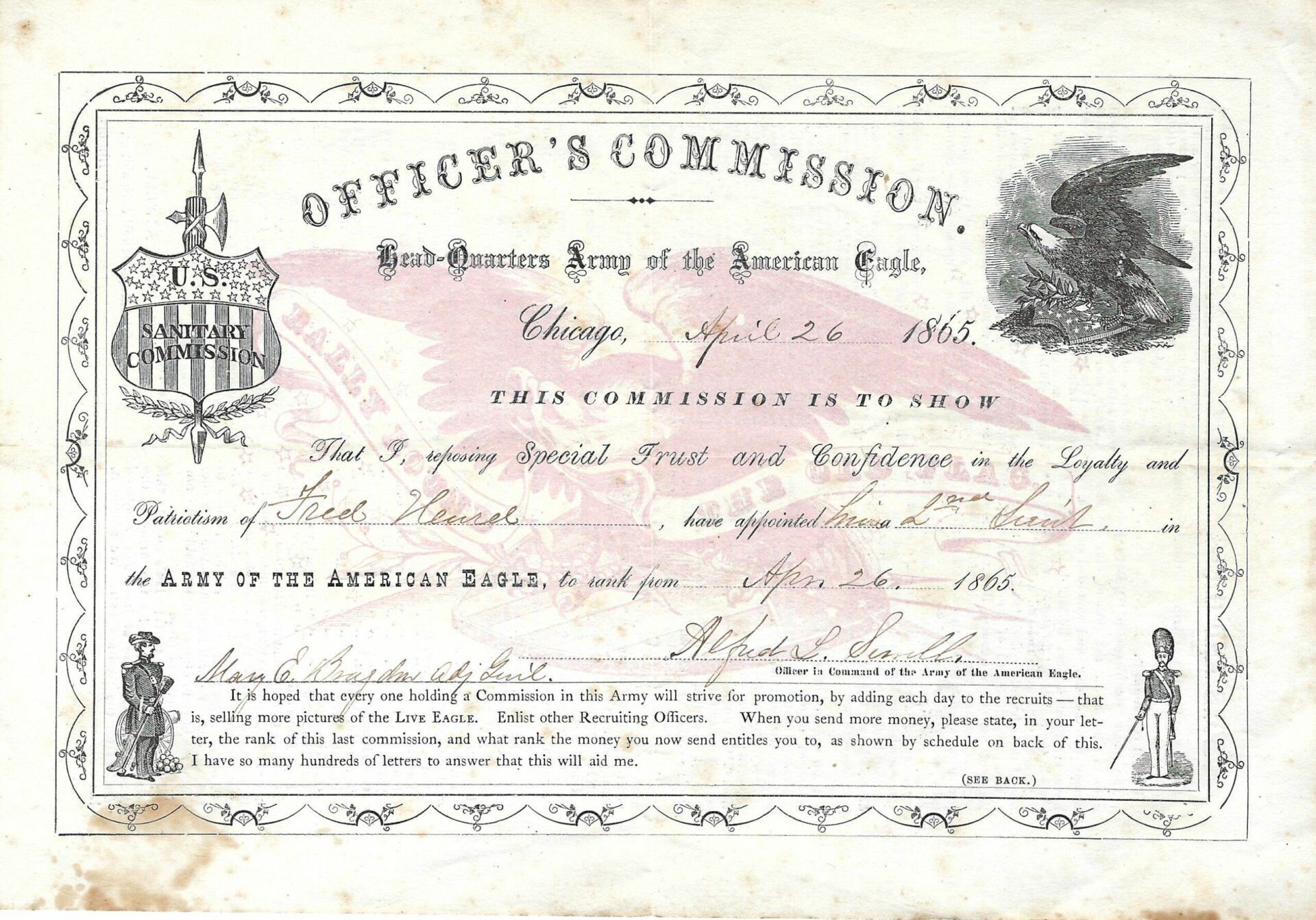
A finely printed and visually striking Civil War–era commission issued under the auspices of the United States Sanitary Commission, bearing the patriotic title “Head-Quarters Army of the American Eagle.” Dated at Chicago, April 26, 1865—just days after the end of major hostilities and within the mourning period following Lincoln’s assassination—this document represents one of the more imaginative and effective fundraising devices employed on the Northern home front.
The commission reads in part:
“**Officer’s Commission.
Head-Quarters Army of the American Eagle.
Chicago, April 26, 1865.
This Commission is to show
That I, reposing special trust and confidence in the loyalty and patriotism of [Fred Hewel], have appointed him a 2d Lieut. in the Army of the American Eagle, to rank from April 26, 1865.
Alfred L. Sewell
Officer in Command of the Army of the American Eagle.**”
The lower printed portion encourages advancement through effort, noting that promotion is tied not to military service but to the selling of patriotic imagery:
“It is hoped that every one holding a Commission in this Army will strive for promotion… by adding each day to the recruits—that is, selling more pictures of the Live Eagle… When you send more money… the rank of this last commission, and what rank the money you now send entitles you to…”
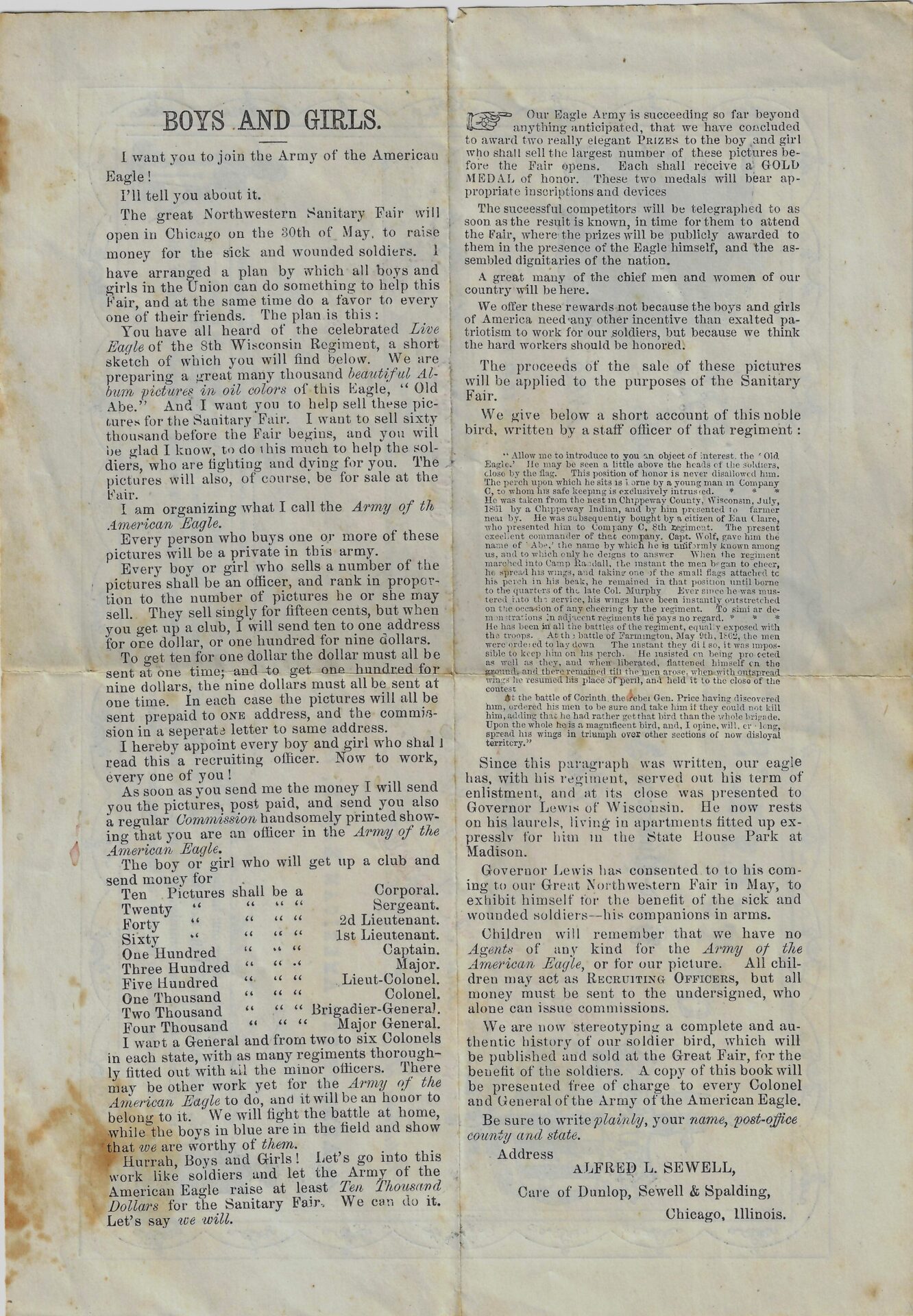
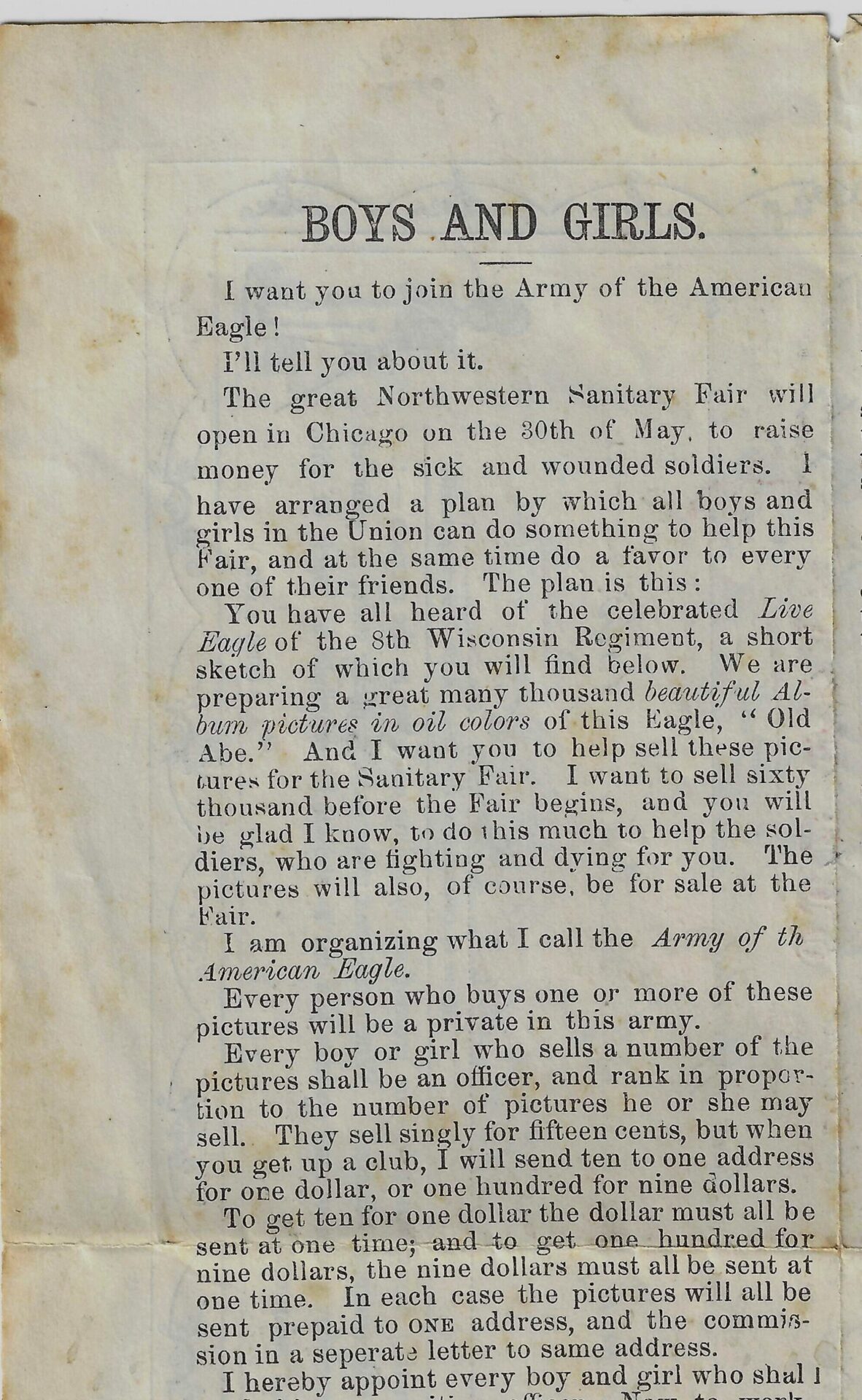
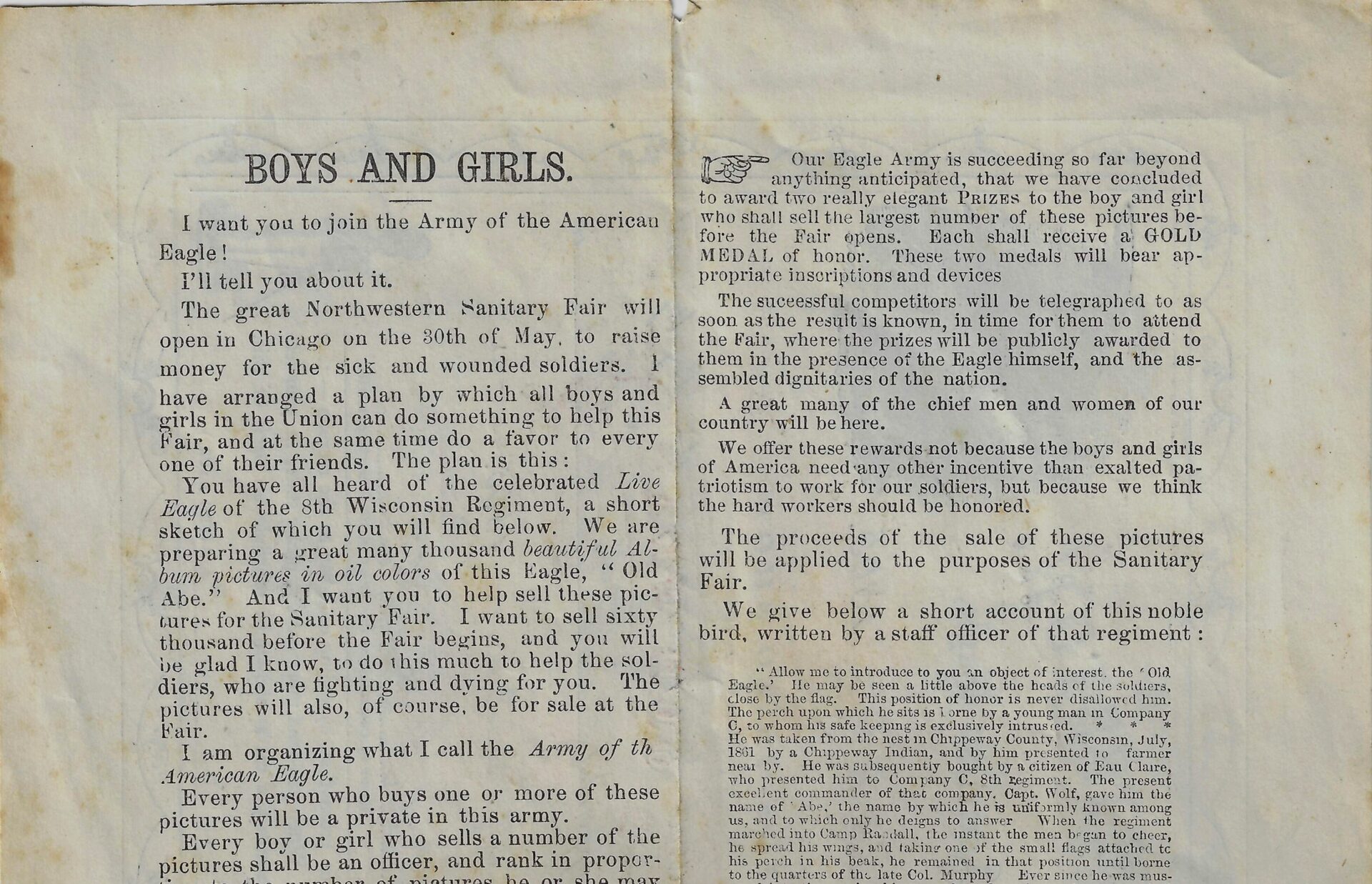
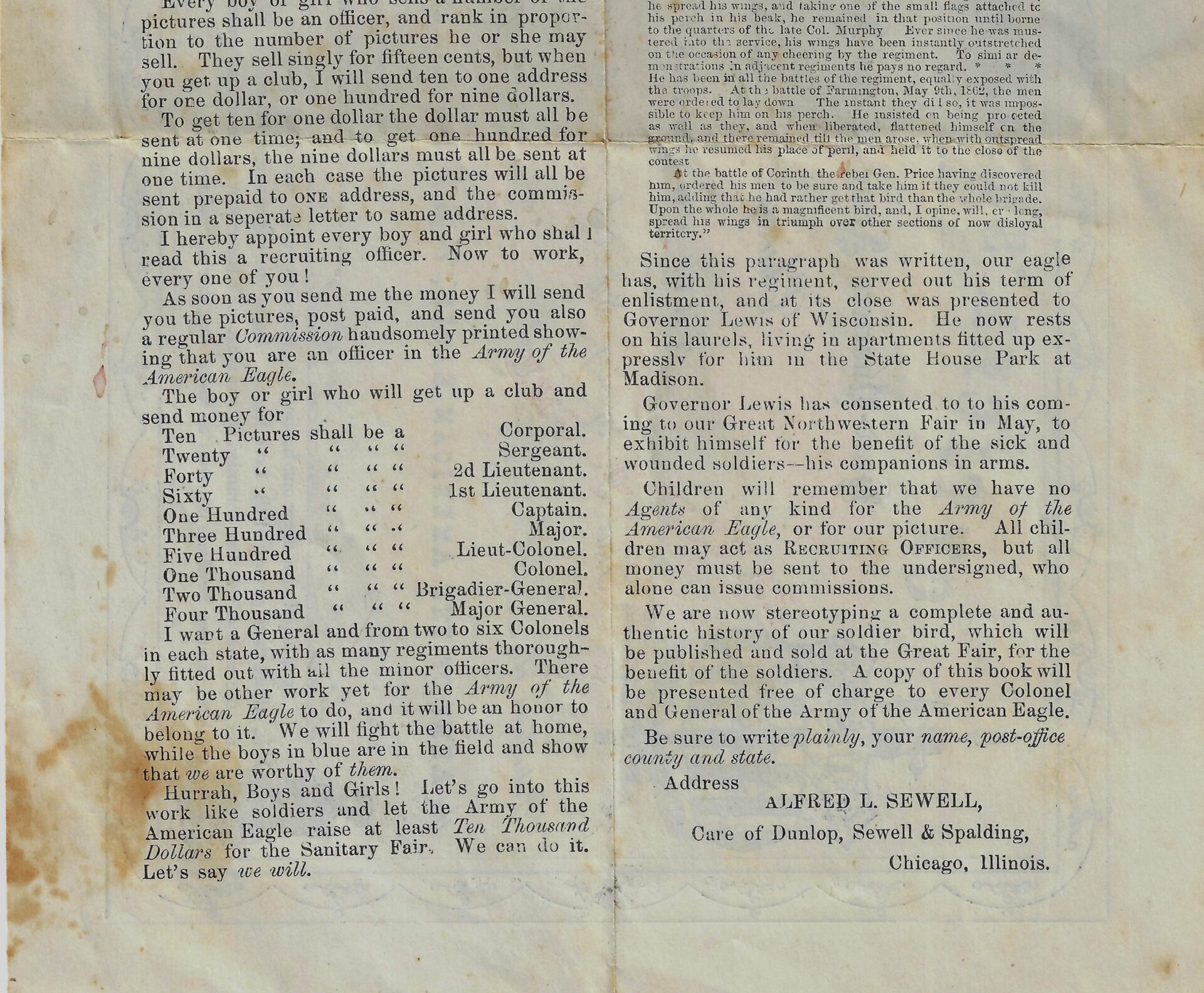
The verso expands this concept into a full recruiting broadside titled “Boys and Girls.” It outlines an organized campaign tied to the Great Northwestern Sanitary Fair, scheduled to open in Chicago on May 30th, 1865. The text appeals directly to Northern youth, encouraging them to sell engraved images of the famed war eagle “Old Abe” of the 8th Wisconsin Infantry, with proceeds benefiting sick and wounded soldiers. Participants were “commissioned” into this symbolic “Army,” with rank determined by the number of pictures sold—ranging from Corporal up through Brigadier General. The structure cleverly mirrors military hierarchy, instilling patriotic zeal while raising funds.
The document also provides a short history of “Old Abe,” the live eagle mascot carried into battle by the 8th Wisconsin, one of the most celebrated animal symbols of the war. It further notes that prominent dignitaries and even the eagle itself would be present at the fair, reinforcing the national importance of the event.
The commission is printed with an ornate border and flanked by patriotic imagery, including a shield bearing “U.S.” and “Sanitary Commission,” topped with a polearm and surrounded by stars, while an engraved eagle vignette occupies the opposite corner. A faint red printed eagle motif is visible beneath the text, adding a subtle layer of visual depth. The piece is signed in manuscript by Alfred L. Sewell, a Chicago publisher and key organizer associated with Sanitary Fair promotional efforts.
Historically, the United States Sanitary Commission was one of the most important civilian organizations of the war, coordinating medical care, supplies, and relief for Union soldiers. Sanitary Fairs—large-scale public fundraising exhibitions—were among its most successful initiatives, blending patriotism, spectacle, and philanthropy. This “Army of the American Eagle” concept reflects the creative methods used to engage civilians, particularly children, in the war effort even as the conflict drew to a close.
An evocative and scarce survivor, this commission captures the intersection of wartime patriotism, civilian mobilization, and postwar transition. Its late-war date, elaborate presentation, and direct connection to the famed Chicago Sanitary Fair and “Old Abe” place it firmly within the most compelling narrative threads of the Union home front in 1865.
Inventory Number: DOC 422
Related products
-

Exceptional Sixth-Plate Tintype of African American Soldier – 14th Rhode Island Heavy Artillery (Colored) Identified Regiment – Rare and Historically Important
$3,200.00 Add to cart -
Grandfather of Douglas McArthur Brigadier General John McArthur
$365.00 Add to cart -
Slavery and the Remedy” (1862) by Samuel Nott with Engraved Slave Trade Print – 4th Edition
$425.00 Add to cart -
English Pistol with Brass Barrel and Grotesque Mask Butt Cap
$895.00 Add to cart


Reviews
There are no reviews yet.